
How to style thick, straight hair for men: a complete guide
You've got a full, thick head of hair. Men who are losing theirs would genuinely trade places with you in a heartbeat. And yet — here you are, standing in front of the mirror, hair going in seventeen different directions, completely refusing to cooperate with the look you had in mind.
Sound familiar?
Thick, straight hair is one of those gloriously frustrating gifts. It looks brilliant when it's working with you. But when it's not? It's heavy, it's bulky, it loses shape by lunchtime, and it seems to laugh in the face of every product you throw at it. You're not doing anything wrong. You've just never been given the right information for your specific hair type — and that's exactly what we're here to fix.
We've put together this guide to walk you through everything: why your hair behaves the way it does, which cuts actually suit it, how to look after it properly, and — most importantly — how to style it step by step so it actually holds. Whether you're after a polished pompadour, a relaxed textured quiff, or something in between, we've got you. Check out our broader guide to the best men's hairstyles if you want even more inspiration alongside this one.
Right. Let's get into it.
Understanding your thick, straight hair: the pros and cons
Before we talk about how to tame the beast, it's worth understanding what you're actually working with. Thick, straight hair isn't just "more hair" — it has a genuinely different structure that changes how it behaves, how it holds product, and how it responds to cutting and styling.
What makes it "thick"?
Hair thickness refers to the diameter of each individual strand, not just the density of how many hairs you have per square inch (though thick-haired men tend to have plenty of both). Thicker strands are physically heavier, which means they resist being pushed into shapes they don't want to hold — and they tend to fall flat or flare out, depending on your particular hair's growth patterns.
Straight hair also has a more uniform cuticle structure than wavy or curly hair, which makes it naturally shinier but more prone to looking flat or one-dimensional without the right cut and styling approach.
The pros (and there are plenty)
- Volume for days. Thin-haired men spend a fortune trying to manufacture the natural fullness you already have.
- Versatility. Thick, straight hair suits a huge range of cuts — short, medium, long — and can pull off styles that finer hair simply can't support structurally.
- Ages well. A full head of thick hair tends to maintain density better over time. Count your blessings, genuinely.
- Takes product well. The extra density means you can use stronger-hold products without them weighing your hair down into oblivion.
The cons (let's be honest)
- Weight. All that hair is heavy. Styles that should stand up — quiffs, pompadours — can collapse under their own weight without the right product and technique.
- Resistance to styling. Thick, straight hair has a strong memory. It wants to grow the way it grows, and it'll fight you on anything else.
- Bulk without shape. Without a good cut, thick hair can look like a helmet. Or a bush. Neither is the vibe.
- Dries out more easily. Thick strands need more moisture to stay supple and manageable. Skip conditioning and you'll end up with something resembling dry straw.
- Frizz and flyaways. Especially in humid summer weather. Every thick-haired man knows the feeling of stepping outside in July and watching his carefully styled hair expand by 40%.
Nearly all of these are solvable with the right cut, the right care routine, and the right products. None of this requires magic. Just a bit of knowledge.
The best haircuts for men with thick, straight hair
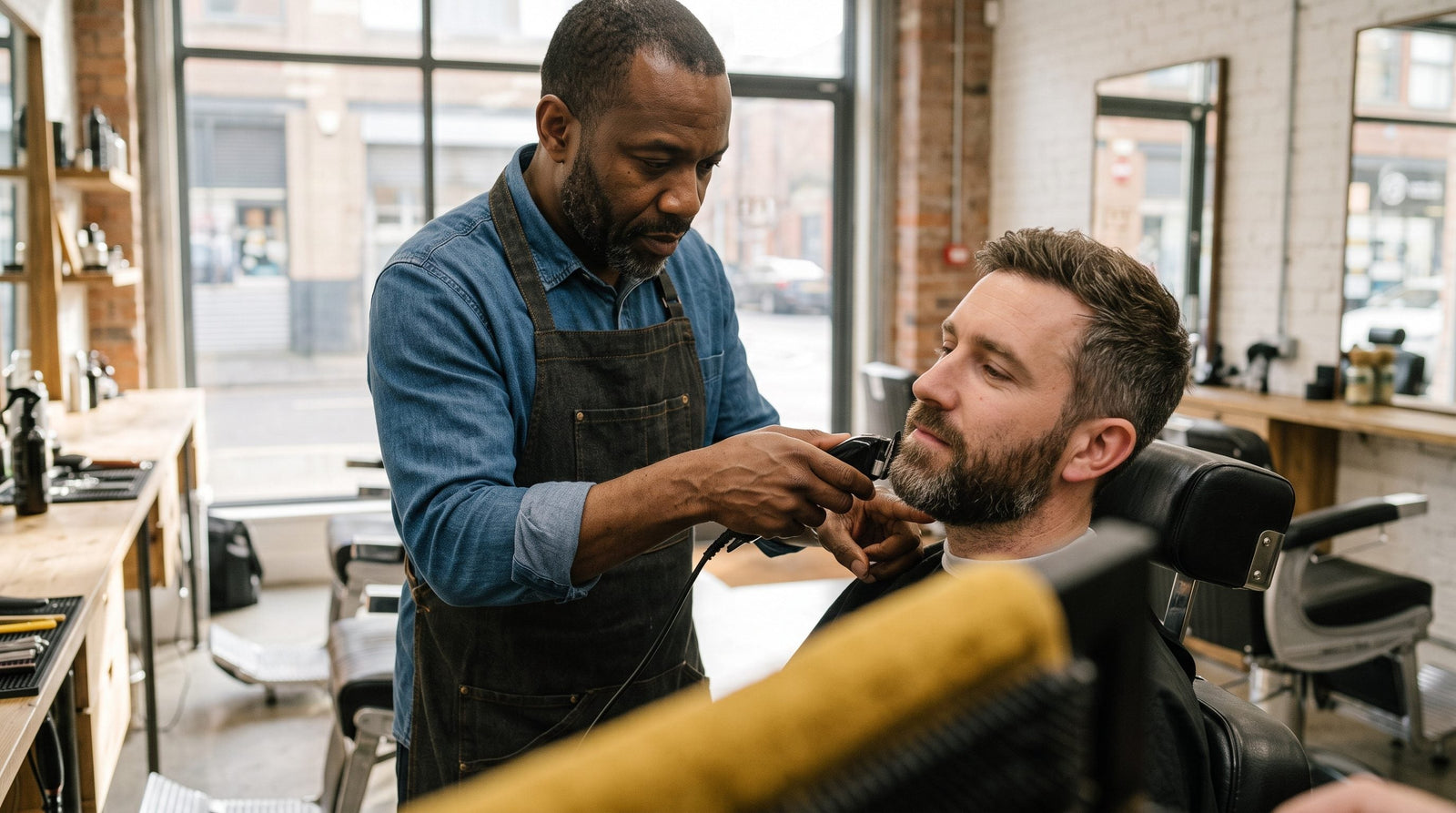
Here's something the barber probably never explained to you: the cut does most of the work. A brilliant haircut on thick, straight hair makes styling almost easy. A bad one makes even the best product useless. The goal with thick hair is always to remove weight strategically — not just length, but bulk — so the hair sits properly and holds a shape.
We've included what to actually say to your barber, because "just make it look good, mate" isn't specific enough. We've all tried it. It doesn't work.
1. The textured quiff
A classic for good reason. The quiff sweeps hair upward and back from the forehead, creating height without looking stiff. For thick hair, the key is texture — you want the top section to have some movement built in, rather than sitting as one heavy block. What to tell your barber: "I'd like a quiff with texture through the top — can you point-cut and thin through the length to remove some weight? Shorter on the sides, but not a tight fade."
2. The pompadour
The pompadour is practically designed for thick, straight hair. It leans into your natural volume and gives it a purpose — upward and back. Elvis knew what he was doing. A modern pompadour is slightly less dramatic, with more texture and a less rigid shape, but the principle is the same. What to tell your barber: "A modern pompadour, please — I want volume through the top with a gradual fade or taper on the sides. Can you thin out the top a little so it doesn't get too heavy?"
3. The side part
Clean, sharp, and genuinely timeless. A side part works beautifully with thick hair because the natural weight of the hair helps it hold the parting in place. It suits almost every face shape and can go from casual to boardroom without much effort. What to tell your barber: "A classic side part — longer on top, tapered or faded on the sides. I'd like a bit of thinning through the top section to help it sit flat rather than puff up."
4. The textured crop
One of the most popular men's grooming styles in 2026. A textured crop keeps the length relatively short on top but builds in movement through choppy, textured ends rather than blunt lines. It's low-maintenance, works brilliantly with clay, and prevents that "helmet head" look that plagues men with thick hair who go for blunt cuts. What to tell your barber: "A textured crop — quite choppy on top with a skin fade or taper on the sides. Point-cut the ends rather than blunt-cutting, please."
5. The undercut
The undercut removes a lot of the weight problem by shaving or cutting the sides very short, leaving length on top. This works especially well if your hair tends to push outward at the sides. The contrast between long top and short sides gives structure that doesn't need to rely purely on product to maintain. What to tell your barber: "An undercut — keep the length on top but I want the sides taken right down, disconnected or with a fade. I've got very thick hair so I need the bulk removed from the sides."
6. The slicked-back look
For men with slightly longer hair. Thick, straight hair is genuinely ideal for a slicked-back style because the natural weight helps the hair lie flat and stay back without constant intervention. You'll need a higher-shine product for this one — a pomade rather than a clay. What to tell your barber: "I want to grow it out and wear it slicked back — can we keep length throughout but taper the sides and remove some of the bulk through the back and sides?"
7. The bro flow (medium-long)
If you're letting it grow, layers are your best friend. Without them, thick hair at medium-to-long length becomes a single heavy curtain that sits flat and shapeless. Layers build in movement and reduce weight without sacrificing length. What to tell your barber: "I'm growing it out — I'd like layers throughout to remove some of the weight and give it more movement. I don't want to lose too much length."
Essential hair care: your daily and weekly routine
This is the section most men skip. Don't skip it. The single biggest reason thick hair is hard to style isn't the lack of the right product — it's that the hair is under-conditioned, dried out, and fighting you before you've even picked up a brush.
How often should you wash?
Here's where a lot of men go wrong. Thick hair doesn't need daily washing. Washing every day strips the natural oils from the scalp and hair shaft, which sounds fine until you realise those oils are what keep your hair supple and manageable. Without them, thick hair becomes coarse, dry, and even more resistant to styling. Two to three times per week is the sweet spot for most men with thick hair.
On non-wash days, rinse with water if needed. Your hair will thank you.
The right way to shampoo
Apply shampoo primarily to the scalp, not the lengths. Work it in with your fingertips — not your nails — using circular motions. Let the lather rinse through the lengths as it washes out. That's genuinely enough for the mid-lengths and ends; they don't need direct application every wash.
Conditioning: non-negotiable
If there's one thing thick-haired men consistently underdo, it's conditioning. Thick hair needs moisture to stay pliable, and a good conditioner is what makes the difference between hair that styles smoothly and hair that snaps back to doing whatever it wants. Apply conditioner from mid-length to ends, leave it for a couple of minutes (actually leave it, don't immediately rinse), then rinse thoroughly.
Our Daily Energising Hair Conditioner hydrates without making hair feel heavy or greasy, which matters enormously when you're dealing with thick hair that already has plenty of weight to it.
Heat and drying
A medium-heat blow dryer — not a scorching hot one — is your friend for thick hair. Blast-drying on maximum heat dries the outer cuticle too fast, leaving the inner shaft still damp, which is a fast track to frizz. Rough-dry first with a towel (press, don't rub), then blow-dry at medium heat while directing the airflow downward along the hair shaft. This smooths the cuticle and reduces frizz.
For many styles — pompadour, quiff, slicked-back — blow-drying is also your opportunity to start shaping the style before product goes in. Use a round brush or your fingers to direct the hair as you dry it. Most tutorials forget to mention this step. It makes a massive difference.
A step-by-step guide to styling thick, straight hair
Right. This is the practical bit. We'll walk through a general styling method that applies across most styles for thick, straight hair, then cover the specifics of a few key looks.
The foundation method (applies to all styles)
- Wash and condition. Start clean. Product applied to dirty hair doesn't hold properly and tends to look greasy by midday.
- Towel-dry — gently. Pat and press rather than rubbing aggressively. You want the hair damp, not soaking, before you reach for the dryer.
- Rough-dry with heat. Get the hair to about 80% dry using a blow dryer. This is when you start directing the hair into the rough shape of your chosen style.
- Apply product to damp (not wet) hair. This matters. Applying product to completely soaking hair dilutes it and reduces hold. Damp is the sweet spot. Take a pea-to-penny-sized amount of clay or pomade, emulsify it between your palms until you can barely see it, then work it through the hair.
- Style with hands first, tools second. Use your fingers to build the rough shape — direction, volume, movement. Then refine with a comb or brush if needed.
- Finish with a final blast of cool air from the dryer if you want the style to lock in place. Cool air closes the hair cuticle and helps the product set.
For the textured quiff
After rough-drying, direct the front section upward and slightly back. Apply a penny-sized amount of hair clay through the top, working from root to tip. Push the front section up with your fingers, then use a comb to refine the shape. Finish by pulling a few pieces forward slightly for texture — you don't want it looking too rigid.
For the pompadour
Blow-dry the front section backward and upward simultaneously using a round brush. Apply a penny-sized amount of pomade through the top section while the hair is still slightly warm from the dryer (the heat helps the product distribute evenly). Use a comb to sweep everything back in one smooth motion, then build height at the front by pushing the hair forward slightly at the root.
For the side part
Establish the parting line while the hair is still damp — use a comb to create a clean line. Dry each side separately, directing hair the way you want it to fall. Apply a pea-sized amount of pomade on the longer side, combing it neatly into place. The shorter side just needs fingers and minimal product.
For the textured crop
This one's the most forgiving to style. After rough-drying, apply a small amount of clay — genuinely just a pea-sized amount, it'll go further than you expect — and work it through the top with a ruffling, upward motion using your fingers. Don't over-comb. The point of a textured crop is natural, dishevelled movement, so the less precise you are, the better it tends to look. Finally, a style where doing less actually works in your favour.
Choosing the right products for your hair type
Let's have the honest conversation about products, because this is where men with thick, straight hair most often go wrong — either choosing something too light that disappears within an hour, or piling on too much of the right thing and ending up with a helmet.

The product comparison: what actually works for thick, straight hair
| Product type | Hold level | Finish | Best for | Water soluble? |
|---|---|---|---|---|
| Hair clay | Strong | Matte | Textured quiff, crop, undercut, casual styles | Yes (most) |
| Pomade | Medium–strong | Shine | Pompadour, side part, slicked-back | Yes (water-based) |
| Hair paste | Medium | Low shine | Relaxed styles, natural finish looks | Yes |
| Salt spray | Light–medium | Matte / textured | Pre-styling texture, beachy looks, layered with other products | Yes |
| Hair powder | Light | Matte | Root lift, adding grip before another product | Yes |
| Gel | Very strong | Wet/high shine | Slicked looks, wet-look styles | Yes |
For thick, straight hair specifically, clay is your workhorse product. It grips the hair shaft without relying on a wet or shiny finish, and the matte texture actually helps thick hair look more dimensional rather than flat. Pomade is the go-to for polished styles where you want some shine. And salt spray is a brilliant pre-styling tool — spritz it into damp hair before drying and it builds in texture that gives subsequent products something to grip onto.
Our product recommendations for thick, straight hair
We formulate all our styling products with natural ingredients, and that matters more than it might sound. Synthetic polymers and heavy silicones — the kind you find in a lot of cheaper styling products — can build up on thick hair over time, making it heavier, duller, and harder to style. Natural formulations work with the hair rather than coating it into submission.
Seven Potions Hair Styling Clay is the one we'd point thick-haired men toward first. Strong hold, matte finish, and it washes out cleanly. The kaolin clay base gives genuine grip without the crunchiness you get from gels, and the natural waxes help piece together texture without stiffness. A pea-sized amount is genuinely enough for most men — go to a penny-sized if you've got particularly dense hair or a longer style.
If you want the full kit, the Hair Clay Style Kit is worth a look — it bundles everything you need to get started without the trial and error of buying things individually.
Seven Potions Hair Styling Pomade is water-based — which means it washes out without the nightmare of oil-based pomades that take three washes and a fair amount of emotional resolve to remove. It gives a medium-to-strong hold with a natural shine that works beautifully for pompadours and side parts. Apply to damp hair and comb through for a polished look.
Seven Potions Salt Texturizing Spray is the secret weapon many men overlook. Spritz it into damp hair before you blow-dry and it builds in a foundation of grip and texture that makes every other product you apply on top work harder. Particularly useful for thick hair because it helps separate strands slightly, reducing that heavy, flat look.
Seven Potions Hair Styling Paste sits between clay and pomade in terms of finish — low shine, medium hold, ideal if you want something more natural-looking without going full matte. Good for relaxed, casual styles or days when you want your hair to look well-groomed but not obviously "done."
And don't forget the basics: our Daily Energising Hair Shampoo paired with the conditioner makes a real difference to how manageable thick hair feels day to day. The shampoo and conditioner together is a simple upgrade that pays off every single time you style.
Troubleshooting common problems for thick, straight hair
Right, let's address the real stuff. The things that happen when you're actually standing in front of the mirror trying to make this work.
Problem: my style falls flat by midday
This is almost always a product issue. Either you're using something with insufficient hold for thick hair, or you're applying it to completely dry hair — product distributes much better through damp hair and sets properly as it dries. Switch to a higher-hold clay, make sure you're applying to damp hair, and use a cool blast from the dryer at the end to lock the style in.
Problem: my hair looks like a helmet
Classic symptom of a blunt cut with no internal texture. This is a barbershop fix — ask for point-cutting and thinning through the bulk sections. In the meantime, use a small amount of clay worked in with your fingers using a ruffling, pulling motion to separate and texture the ends. Avoid combing everything into one smooth shape.
Problem: flyaways and frizz
Thick, straight hair is prone to frizz, especially in humid conditions. The fix is usually two-fold: more conditioning (seriously, condition every wash without fail), and directing the blow dryer airflow downward along the hair shaft rather than at it from random angles. A small amount of paste or pomade smoothed over the surface also helps tame flyaways once the style is in.
Problem: product buildup
If your hair feels perpetually heavy and dull despite washing regularly, you may have buildup from styling products. Use a clarifying wash once a week (or every couple of weeks) to strip residue. Switching to water-based products like ours also helps — they wash out cleanly rather than accumulating over time.
Problem: my hair grows outward instead of lying flat
This is particularly common in men with thick, coarse hair, and even more so in men with naturally straight Asian hair. The weight of each strand is actually working against you at shorter lengths. The solution is usually to either grow it long enough that the weight starts pulling it down, or work with the direction rather than fighting it — a textured crop or undercut that embraces volume rather than trying to flatten it can look brilliant. A strong-hold clay applied from root to tip while directing the hair with a brush can also help train it over time.
If you're experiencing hair that's thinning rather than thick, we've also put together a dedicated guide on the best hairstyles for men with thinning hair — worth a read.
Tips and tricks: getting the most from your thick, straight hair
- Apply product to damp, not wet hair. Always. Wet hair dilutes and distributes product unevenly. Damp hair — about 80% dry — gives the best hold and finish.
- Less product than you think. Thick hair fools you into thinking you need more. Start with a pea-sized amount, work it fully through, then add a tiny bit more only if genuinely needed. You can always add; you can't take away.
- Emulsify properly. Rub product between both palms until you can barely see it before touching your hair. Product that hasn't been warmed and distributed properly clumps and creates uneven hold.
- Use the cool shot. The cool air button on your dryer is genuinely useful. Once your style is where you want it, a quick cool blast closes the cuticle and helps everything stay put significantly longer.
- Blow-dry in the direction of growth first. Before styling, one pass with the dryer going with the growth direction smooths the cuticle and reduces frizz as a baseline.
- Condition every single wash. Not optional for thick hair. This is the single most impactful thing you can do for long-term manageability.
- Get your hair cut every 6–8 weeks. Thick hair grows fast and loses shape quickly. Longer between cuts means more styling effort. Keep it fresh and your morning routine shortens dramatically.
- Try layering products. Salt spray on damp hair before drying, followed by clay once dry, gives you better texture and hold than either product alone. Experiment with combinations.
- Sleep with a loose style. If you go to bed with your hair scraped back tightly or in a rough position, you'll fight it in the morning. Even a loose arrangement in roughly the right direction helps.
- Invest in a quality comb. A wide-tooth comb for detangling damp hair, and a finer one for styling. Cheap plastic combs create static. Quality combs do not.
Frequently asked questions
How to style thick straight hair for men?
Wash two to three times per week and condition every wash to keep thick hair pliable and manageable. Apply a high-hold matte clay to damp hair, emulsify it fully between your palms first, then style using fingers before refining with a comb. Finish with a cool blast from the dryer to lock the style in place and reduce frizz.
How to style coarse straight hair men?
Coarse, straight hair needs extra moisture — make conditioning non-negotiable and look for products with hydrating ingredients that soften the hair shaft before you even reach for a styling product. Use a strong-hold clay or pomade applied to damp hair, work it in thoroughly from roots to ends, and use a boar-bristle brush to help distribute both the product and your natural oils evenly. The key with coarse hair is softening it first. Trying to style it dry and under-conditioned is a battle you will always lose.
How to style long thick straight hair men?
Long, thick, straight hair needs layers — ask your barber to cut them throughout the length to remove weight and build in movement, because without them it will sit as one heavy, flat curtain. A small amount of paste or lightweight pomade worked through the mid-lengths and ends gives control without adding heaviness; a salt spray on damp hair before drying builds in texture that makes the whole thing look less flat. If you're having a rough day, a loose bun or low ponytail using a fabric hair tie (not elastic, which breaks thick hair) is always a legitimate option.
How to style short thick straight hair men?
Short, thick, straight hair tends to push outward rather than lying flat, so the cut is everything — a textured crop, skin fade, or undercut removes the bulk that causes this. Style with a small amount of clay worked in with a scrunching, upward finger motion to build texture and separate strands rather than trying to flatten them. Embrace the volume; short thick hair styled with its natural tendencies almost always looks better than one that's fighting them.
How to style thick straight Asian hair men?
Thick, straight Asian hair tends to be particularly dense and resistant to taking on new shapes — the individual strands are often coarser and the hair grows strongly in its natural direction, which makes it prone to sticking out at shorter lengths. The most important barbershop request is weight removal — thinning shears and point-cutting through the bulk sections — so the hair lies properly without a blunt, puffy outline. Use a strong-hold clay and blow-dry while directing the hair firmly into your desired shape; consistently directing hair the same way during drying does add up over time.
Final thoughts
Thick, straight hair is genuinely one of the more versatile things you can have on your head. The volume is already there. The structure is already there. What it needs is a cut that removes weight in the right places, a care routine that keeps it hydrated and manageable, and products that actually have enough hold to keep up with it throughout the day.
The men who struggle with thick hair are almost always the ones who've been given advice designed for a different hair type entirely, or who've been reaching for the nearest product without really understanding what it does. Now you know better.
Get yourself a good barber conversation, invest in a proper clay or pomade, condition every single wash, and enjoy having the hair that thinner-haired men actively envy. You've earned it.
And if you want to keep up with what's current in men's grooming beyond just hair styling, our 2026 grooming trends roundup is a good next read.