
You've sat down in that chair and gone completely blank, haven't you?
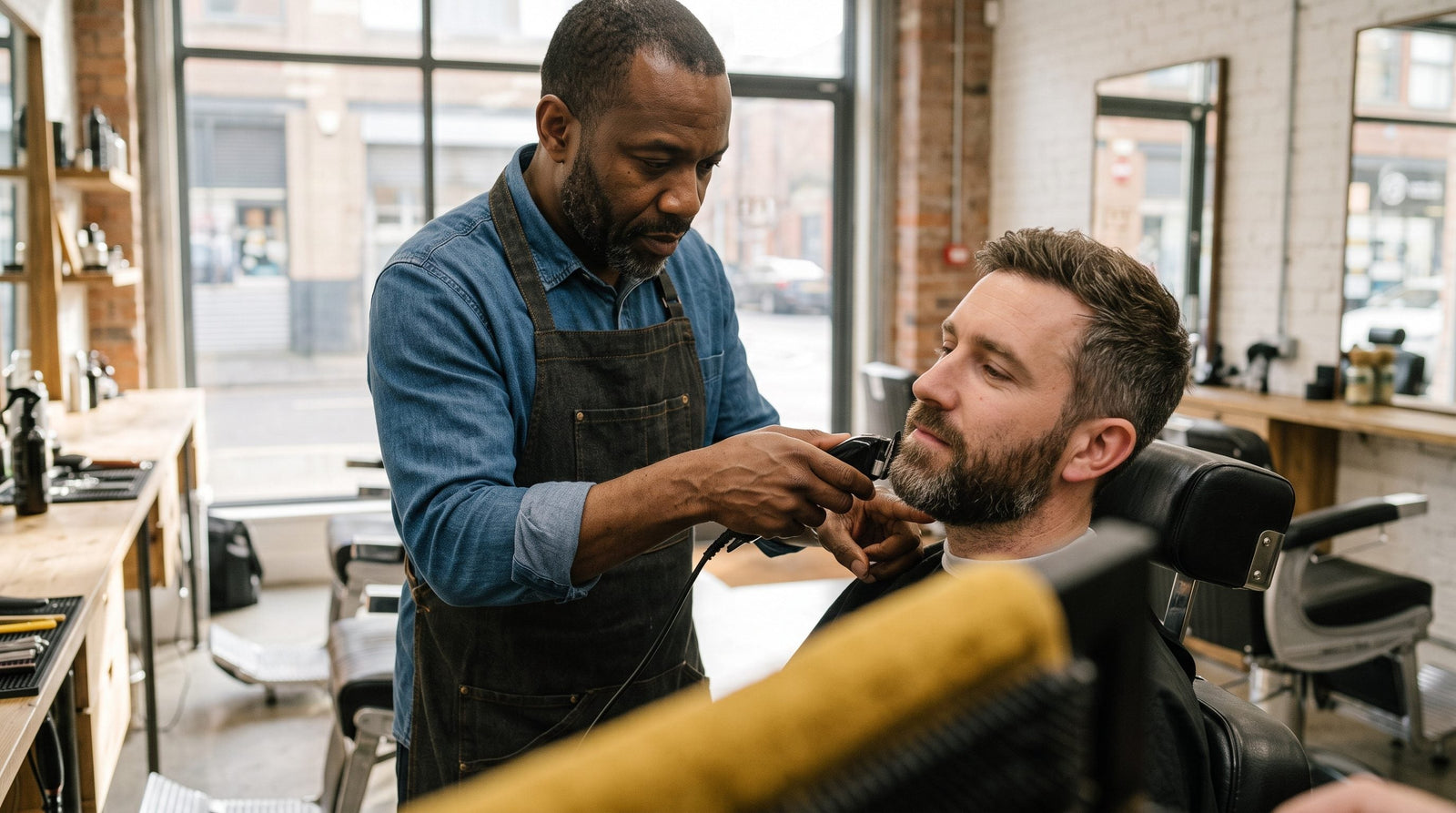
We've all done it. You walk into the barbershop with a crystal-clear vision in your head — something sharp, modern, maybe a little bit David Beckham circa his Salford City era — and the moment your barber swings round and says "so, what are we doing today?", your mind empties like a pint glass at last orders. You mutter something like "just a tidy up, maybe a bit shorter on the sides" and then spend the next 20 minutes watching something vaguely not-what-you-wanted take shape in the mirror.
That's the experience a lot of men have, and nobody talks about it. Every barbershop guide out there tells you to "be specific" and "use the right terminology." Useful advice, sure. But what about the bloke who freezes up the moment someone points a set of clippers at him? What about knowing what to say when the cut's going wrong mid-chair? Or how to give feedback afterwards so next time is actually better?
That's what this guide is for. Your complete barbershop handbook — from the prep work you do at home, to speaking the language, to keeping your beard looking its best after you leave. And yes, we'll cover what to do when things aren't going to plan, because that deserves more than a polite wince and a forced "yeah, looks great, cheers."
Before you go: prep work for the perfect haircut
The biggest mistake men make at the barber's is walking in unprepared. Not unprepared as in "I forgot to wash my hair" (though please, do wash your hair). Unprepared as in no reference points, no knowledge of their own hair type, and no real idea of what they actually want.
Five minutes of prep at home fixes all of this.
Step 1: know your hair type and face shape
A style that looks incredible on someone with thick, straight hair can look entirely different on someone with fine, wavy locks — and not in the way you're hoping. Your face shape plays a major role too; a good haircut creates balance and proportion, not just length.
Broadly speaking:
- Oval face: Lucky you. Most styles work well. The world is your oyster.
- Round face: Go for more height on top and less width on the sides. Avoid bowl cuts (please, avoid bowl cuts).
- Square face: Softer styles and textured tops balance a strong jawline nicely. Harsh, angular cuts can make you look like you're carved from granite.
- Oblong/rectangular face: Keep the top flatter and avoid too much height. You don't want to add length to a face that already has plenty.
- Heart-shaped face: More volume at the sides balances a wider forehead. Think texture over height.
And your hair type — straight, wavy, curly, coily — matters just as much. A high fade with a textured top behaves very differently on 2c wavy hair versus 3b curls. Knowing this before you sit down means you can have a much more informed conversation with your barber.
Step 2: bring reference photos. Seriously.
Not only is it perfectly acceptable to show your barber a photo — it's actively encouraged. Photos remove the ambiguity that verbal descriptions always carry.
"Shorter on the sides" means something different to every person on the planet. A photo does not.
Collect two or three references — ideally showing the front, side, and back if you can find them. Pinterest, Instagram, and even a quick search for your favourite footballer's current haircut will do the job. Don't worry about finding someone with your exact hair type. Your barber is trained to translate the style onto your specific hair. Adapting a cut to whoever's sitting in the chair is a core part of what they do.
Step 3: think about your lifestyle
A disconnected undercut with a voluminous textured top might look brilliant — but if you're up at 6am, you've got a commute, and you spend roughly 45 seconds on your hair each morning, you're going to be miserable maintaining it. Talking through your lifestyle and daily styling commitment with your barber helps them steer you towards something manageable and realistic, rather than aspirational but impractical.
Ask yourself honestly:
- How much time am I willing to spend styling each morning? (Be honest. "Five minutes" usually means two.)
- Do I work in a formal environment or a casual one?
- Do I play sport regularly or spend time outdoors?
- Am I willing to come back every 3–4 weeks for maintenance, or do I need something that grows out gracefully?
If you've also been working on your overall grooming routine, you'll already know what products you're comfortable using daily — that's useful context to share with your barber too.
The consultation: speaking your barber's language
The apron's on. Your barber's looking at you expectantly. This is the moment most guides abandon you with "just be specific!" — which is about as helpful as telling someone to "just be confident" on a first date.
Here's a structure that actually works.
Lead with the feeling, then the technical detail
Start by describing the overall direction: "I want something cleaner and more modern than what I've got," or "I want to keep the length but smarten it up," or "I want something that takes minimal effort in the morning." This gives your barber a creative brief to work from. Then layer in the specifics — lengths, fade types, neckline style — which we'll cover in the next section.
A script for the socially anxious
Look, not everyone is naturally chatty. Some of us find unsolicited small talk about our weekend plans mildly excruciating, let alone trying to describe a haircut under pressure. If that sounds familiar — you're not alone, and there's no shame in it.
Here's a simple, low-pressure script you can actually use:
"I've got a couple of reference photos on my phone — is it okay if I show you? I want [brief description: e.g., 'something like this, with a fade on the sides']. I've got [hair type, e.g., 'quite thick, slightly wavy hair'] and I usually spend about [X minutes] on it in the morning. What do you think would work for me?"
That's it. Show the photo, give your context, ask for their opinion. Your barber is a professional — they genuinely enjoy this part. You're not being difficult. You're being a good client.
Let them talk
Once you've delivered your brief, stop talking and listen. A good barber will confirm what they've heard, ask a clarifying question or two, and perhaps suggest a modification based on your hair type or face shape. That's expertise — take it on board. They're not trying to sell you something different; they're trying to make sure the end result is actually going to look good on you.
Key haircut terminology every man should know
You don't need to become a barber to talk like you know what you're asking for. A handful of terms covers most situations. Here are the ones that genuinely matter.
Fade vs. taper
These two get used interchangeably all the time, but they're different things. A taper keeps the hair longer on top and gradually shortens it down towards the neck — subtle, clean, and works in professional settings. A fade is more dramatic: it transitions from longer hair to shorter more aggressively, often going all the way down to the skin. Knowing which one you want will save you a considerable amount of silent disappointment.
Clipper guard numbers
Clipper guards correspond to specific hair lengths. Each number is roughly an increment of 1/8th of an inch — so a #1 guard leaves roughly 1/8", a #2 leaves 1/4", a #3 leaves 3/8", and so on. When someone says "short back and sides," a barber needs an actual number to work with. "A #2 on the sides fading up to a #4" is a real instruction. "Not too short" is a prayer.
Neckline styles
The neckline is one of those details that most men don't think about until they see it and realise it matters enormously. Three main options:
- Blocked (squared): A sharp, straight horizontal line across the back. Very clean and defined. Grows out quickly and becomes obvious faster.
- Rounded: Corners are softened into a curve. Slightly less harsh than a block, still tidy.
- Tapered: Follows the natural hairline, creating a softer, more gradual finish. Grows out more gracefully — ideal if you're not coming back every three weeks.
Other terms worth knowing
| Term | What it means | When to ask for it |
|---|---|---|
| Texture/texturising | Removing bulk and adding movement through point-cutting or razoring | When your hair feels heavy or sits flat |
| Disconnected | A visible, unblended contrast between the top and sides | For a bold, modern style — not subtle |
| Blended/graduated | A smooth, gradual transition between lengths | For a classic, versatile look |
| Undercut | Sides and back clipped very short underneath a longer top | When you want contrast without a fade |
| Hard part | A shaved or razor-defined parting line | For a sharp, defined side parting |
| Point cutting | Scissors cutting vertically into the hair ends to create softness | Reducing bulk in thick or coarse hair |
| Skin fade / bald fade | Hair tapers all the way to the skin — no guard | Maximum contrast, high maintenance |
You don't need to memorise all of these. Even knowing the difference between a fade and a taper, and having a neckline preference in mind, puts you miles ahead of walking in and saying "the usual."
If you've ever had to navigate the related world of beard fades as well, our at-home beard fade guide is worth a read before your appointment.
During the cut: how to give constructive feedback
Here's the section nobody else writes. What do you actually do when the cut is in progress and something isn't right?
Men spot it going wrong around the five-minute mark, say absolutely nothing, watch the whole thing unfold in the mirror with increasing unease, and then tell the barber it looks great. They go home sad. They don't come back.
Please don't do this. Your barber would far rather you say something early — ideally before too much hair has come off — than finish a cut that doesn't make you happy. Corrective feedback mid-cut is not rude. Done right, it's the mark of a client a barber actually respects.
How to say something (without being awkward)
The key is calm, early, and constructive. Here are a few real scripts:
If something looks too short: "Could we slow down on the sides actually? I think I want to keep a bit more length there — it's looking shorter than I had in mind."
If the fade isn't blending as expected: "I'm not sure about the transition from the sides to the top — it feels a bit abrupt to me. Is there a way to blend it a bit more?"
If you're genuinely unsure: "Can I just have a quick look from the side before we go further? Just want to check I'm happy with the length."
Any decent barber will immediately pause, check in with you, and adjust. If they seem irritated by a polite, reasonable request mid-cut... well. Time to find a new barber.
The golden rule
Once the hair is gone, no barber on earth can put it back. The moment you spot something that doesn't look right — say so. That's your window, and it closes fast.
After the cut: styling, maintenance, and upkeep
You've got a great haircut. Brilliant. Now don't immediately wreck it by going home and doing nothing.

Post-cut is the ideal time to ask your barber how they styled it — what product they used, how much, and in which direction they worked the hair. Ask while you're still in the chair, while the style is fresh in front of both of you.
How to make your cut last
A fresh cut will look its best for the first two weeks, then it'll need either a maintenance trim or clever styling to keep looking sharp. A few principles that genuinely help:
- Wash your hair correctly. Over-washing strips natural oils and makes your hair harder to style. Most hair types do well with washing every two or three days. Fine hair may need more frequent washing; coarser, curlier hair often benefits from less.
- Get the right styling product for your hair type. Not all products are equal — a water-based hair styling pomade gives a sleeker, higher shine finish, while a hair styling clay delivers a matte, textured result with more volume. Neither is better — it depends entirely on the style you're after.
- Apply product to slightly damp hair for most styling products. It distributes more evenly and gives better hold without that crispy, overworked look.
- Book your next appointment before you leave. If you've got a clean fade, it'll need attention in 3–4 weeks. Longer styles can go 6–8 weeks. Waiting until it's grown out to the point of looking shapeless means starting from scratch every time.
Post-cut communication for your next visit
This one's genuinely underused. After a cut that went well — tell your barber specifically what you loved about it. "The length on top was exactly right" or "the fade was spot on" gives them a reference point for next time. After a cut that didn't go quite right, a brief, calm note at the end is always preferable to leaving quietly and never returning: "I think next time I'd keep the sides a little longer — but thanks, I appreciate it." A good barber will note that and adjust.
What products should I use after my haircut?
Let's talk product — because a great haircut deserves great product to maintain it, and your barber (if they know their stuff) will probably ask what you're currently using anyway.
Beard oil
If you're rocking a beard alongside your fresh cut, beard oil is non-negotiable. Our beard oils are built around carrier oils — jojoba and argan being the workhorses — chosen for what they actually do to facial hair rather than how they sound on a label. Jojoba is particularly clever because it mimics sebum, your skin's own natural oil, which means it moisturises the skin underneath the beard without clogging pores or feeling greasy. Argan is high in oleic and linoleic acids, which soften coarse beard hair and add a healthy sheen. Sweet almond rounds things out with a lighter, faster-absorbing texture that suits finer beards well.
A few drops — three to five for a short beard, five to eight for longer — warmed in your palms and worked through the beard morning and evening is all it takes. Within a week, most men notice a real difference in softness and how the beard sits. We have scented options like our Citrus Tonic and Woodland Harmony, and a completely unscented Pure Equilibrium for those who prefer their aftershave to do all the talking.
Beard balm
Think of beard balm as beard oil's more structured sibling. Our Woodland Harmony Beard Balm combines the moisturising power of oils — coconut, peach kernel — with the holding and shaping properties of cocoa butter and natural waxes. The result is a product that conditions your beard and gives you enough hold to tame flyaways, shape the neckline, and generally keep things looking intentional rather than chaotic.
A penny-sized amount is genuinely enough for most beard lengths. Scrape it between your fingers to warm it, then work it through the beard from root to tip. It's particularly useful in the morning when you want your beard to complement a sharp haircut rather than compete with it.
Beard brush — oval shaped pear wood with natural boar bristles
A good beard brush makes an immediately visible difference. Our oval pear wood brush with natural boar bristles trains the beard to grow in a consistent direction and distributes natural oils — and any product you've applied — evenly from root to tip. The result: a fuller, tidier, shinier beard with noticeably less itching and beardruff.
Use it after applying your beard oil or balm. Start brushing downwards from beneath the chin, then brush outward from the cheeks. It takes about 30 seconds and makes your beard look like you've actually made an effort — which, after a fresh haircut, is exactly the energy you want.
If you want to get everything in one go, the Beard Grooming Set pairs the oil, shampoo, and brush together. A reasonable place to start if you're building your routine from scratch and don't want to think too hard about it.
Beyond the haircut: asking for total grooming advice
Your barber is trained in beard shaping, skin care, facial hair styling, and product knowledge — and most men leave a huge amount of value on the table by never asking a single question beyond the haircut itself.
A few questions worth raising while you're there:
- "How would you suggest I shape my beard to complement this haircut?" — Particularly relevant if you're letting your beard grow. The right beard shape can change how your whole face reads. A barber who's just cut your hair is perfectly placed to advise on proportions.
- "What neckline do you recommend for my beard given my face shape?" — They'll have strong, useful opinions. Take notes.
- "How often do you think I should be coming in to keep this looking sharp?" — Get a realistic schedule, not just a hopeful one.
- "What product did you use on my hair just now, and how do I recreate this at home?" — Particularly useful if the barber's styling looked significantly better than your usual home attempts. (It usually does.)
We've put together a thorough minimalist grooming guide for 2026 if you want to think about the bigger picture of your routine — not just the haircut, but everything around it.
And if your skin's been causing you trouble lately — especially around the beard area — it's worth flagging with your barber too, since beard acne and irritation can often be addressed with the right product choices before they become a real problem.
Quick-reference checklist
The practical summary. Use it before your next appointment.
Before you go: save two or three reference photos on your phone showing different angles of the style you want; know your hair type and face shape; decide honestly how much time you're willing to spend styling daily; consider whether you want a style that grows out gracefully or a sharper look that needs regular upkeep; wash your hair before the appointment.
In the chair: lead with your photos, then describe the feeling you want, then add technical detail; know the difference between a fade and a taper; have a neckline preference in mind; if something looks wrong mid-cut, say something calmly and early; ask how they styled it before you leave.
After your cut: book your next appointment before you walk out; get the right styling product for your hair type; apply a pea-sized amount of clay or pomade to slightly damp hair; keep your beard looking considered with daily beard oil and a boar bristle brush; give specific feedback at the end — what worked, what you'd change. And check out our guide to fixing beard itch and dandruff if the skin under your beard is causing trouble — a fresh cut deserves a well-kept beard to match.
Frequently asked questions
How do I tell my barber what I want?
Photos first. Always. Show two or three references, describe the overall feel you're after ("cleaner and more modern," "easier in the morning"), add whatever technical detail you know, and then ask your barber what they think given your hair type. That last bit matters — you're not just placing an order, you're having a conversation. A quick script: "Here are a couple of photos — I've got [hair type] and I usually spend about [X minutes] on it. What do you think would work?" Done.
Is it rude to show your barber a picture?
No. Bring the photo. Most barbers prefer it. A picture removes the ambiguity that comes with verbal descriptions — "shorter on the sides" means something different to every person in the room, and a photo does not. Show it confidently and let them work with it.
What should you not say to a barber?
Avoid vague, unmeasurable phrases: "just a trim," "not too much off," "the usual" — unless you've been seeing the same barber for years and they genuinely know your hair. These phrases mean something different to every person in the room, which is precisely how you end up with a haircut you didn't want.
Also: don't wait until the end of the cut to voice a concern that started five minutes in. Say something early, calmly, while there's still something to be done about it. Silently watching it go wrong and then saying it looks great helps nobody.
The chair's yours. Use it well.
Walking into a barbershop and getting exactly the haircut you wanted isn't some mysterious skill reserved for men with naturally good hair and photographic memories. It's a conversation — and like any conversation, it goes better when you turn up prepared, know a bit of the language, and aren't afraid to speak up when something isn't right.
You now know how to prep before you go, how to actually communicate in the chair, what to do if things aren't going to plan, and how to make the most of your barber's expertise beyond just the cut itself.
Pair a great haircut with a well-maintained beard — a little beard oil morning and evening, a beard balm for shape and hold, and a good brush to keep everything in line. Sharp hair, a tidy beard. Go get that haircut.