
The Great Grooming Debate: At-Home Cuts vs. The Barber's Chair
You're standing in the bathroom. It's a Tuesday evening. Your hair is starting to curl over your ears, your neckline looks like it was designed by someone with a grudge, and your next barber appointment isn't for another three weeks. Sound familiar?
The question of DIY haircut vs. barber crosses every man's mind eventually — usually at the exact moment he's holding a pair of scissors and staring into a slightly-too-small bathroom mirror. And in 2026, with the cost of pretty much everything going in exactly one direction, it's worth answering properly.
Here's the thing: most articles on this topic pick a side. Either they're written by a barbershop (spoiler: they vote for the barbershop) or by someone who once accidentally shaved off their own eyebrow and now considers themselves an authority on home grooming disasters. Neither perspective is all that useful if you're trying to make a smart decision.
So we're not picking a side. We're laying it all out — the costs, the skills involved, where each approach actually earns its keep — and then giving you practical tools to work smarter. Because the smartest approach isn't purely one or the other. It's knowing how to combine both. We've touched on related territory in our ultimate guide to building a grooming routine, and the same principle applies here: the best system is the one that fits your actual life.
The professional edge: the case for visiting a barber
A good barber is impressive. Not in an "oh, that's nice" way — in a "how did you do that in 25 minutes when I've been trying to blend my own fade for two hours" way.
There are very real, very compelling reasons to keep a regular relationship with a barber, and they go beyond the free conversation that comes with the chair.
1. They know what they're doing — and it shows
A trained barber spends years learning how hair actually behaves — how your natural growth pattern affects the final result, how to blend a fade so it doesn't look like a geography map, how to taper without creating a hard line. They can spot within about thirty seconds whether your parting is fighting your hair's natural direction. You probably can't. Most of us can't. That's fine.
That expertise shows up directly in the cut. If you're after something precise — a skin fade, an undercut, a textured crop with a defined fringe — this is difficult territory for a home clipper. Not impossible, but the margin for error is almost zero, and the consequences of crossing that line are visible every time you look in the mirror. For a full rundown of what different cuts actually involve, our guide to classic men's haircuts breaks it down well.
2. The experience is part of the value
There's something to be said for sitting down, handing over responsibility, and walking out looking sharper than when you walked in. The barbershop ritual — the hot towel, the straight razor on your neckline, the conversation about last night's match — has a genuine psychological value. It's one of the few places where you're actively being looked after, and that matters.
It also nudges you out of your comfort zone in a good way. A barber might suggest something you wouldn't have thought of. A slightly shorter taper. A different fringe. You leave with a fresh perspective. That's worth something.
3. Consistency over time
Find a good barber and stick with them, and they learn your hair. They know it grows faster on the left. They know you're not adventurous with length. They know you want the sides tight but not too tight. That accumulated knowledge produces increasingly better results over time. It's a relationship. A slightly one-sided one, but still.
4. The complex stuff stays complex
Skin fades, scissor-over-comb blending, textured quiffs, hard parts — these aren't skills you pick up from a YouTube tutorial in an afternoon. They require practice, the right tools, and an angle you literally cannot achieve on your own head. For these styles, a barber isn't a luxury. It's just the right tool for the job. And knowing how to talk to your barber effectively makes the whole process even smoother.
The home advantage: the argument for DIY grooming
And yet. Many men cut their own hair — or at least maintain it between barber visits — and their hair looks absolutely fine. More than fine, in many cases. Because for certain styles, in certain situations, doing it yourself makes complete sense.
1. The long-term cost adds up fast
According to data from Modern Barber, the average men's haircut in the UK costs around £13. That sounds reasonable until you factor in frequency — trims are typically recommended every two to six weeks, which works out to roughly £108 or more annually at the lower end. And that's the national average. In London, Manchester, or Edinburgh, you're looking at considerably more.
A decent home clipper kit — something like the Wahl Elite Pro, which comes with guide combs, scissors, a barber comb, and a storage pouch — costs around £64 as a one-off purchase. You recoup that investment within a few months. Over several years, the savings are hard to argue with.
2. Convenience on your own terms
No appointment. No waiting. No rearranging your Tuesday evening because the barber had a cancellation at 5pm and nothing until next week. If your neckline is bothering you on a Sunday morning, you can fix it. That kind of flexibility — especially for men with unpredictable schedules — is worth a lot.
3. Total control
Some men know exactly what they want and find it mildly frustrating to explain it, wait, and then discover it's not quite right. At home, you're in charge. You can be as precise or as relaxed as you like. You can take it slow. No pressure.
4. Simple styles are very manageable
A buzz cut. A number two all over. Tidying the neckline. Trimming the sides between proper cuts. None of these are beyond a patient beginner with decent equipment. The learning curve is real — we'll be honest about that — but for straightforward maintenance, it flattens out quickly.
5. The honest downside: mistakes are yours to own
Nobody is going to sugarcoat this. DIY haircuts carry risk. The most common beginner mistake is cutting too much at once, usually because the wet-hair-versus-dry-hair illusion catches you out. Second most common: using tools that aren't up to the job. Kitchen scissors and cheap clippers produce kitchen-scissors-and-cheap-clippers results. That's not a judgement — it's physics.
The good news is that both mistakes are avoidable with the right approach. Which we'll cover properly below.
Head-to-head breakdown: cost, time, and quality compared
Here's how the two options stack up across the things that actually matter:
| Factor | Professional barber | DIY at home |
|---|---|---|
| Upfront cost | Low (per visit) | Moderate (tools investment, ~£60–£100) |
| Annual cost (est.) | £108–£300+ depending on location & frequency | ~£0 after initial investment (ongoing: minimal) |
| Time per cut | 30–60 min (including travel & waiting) | 15–30 min (once practised) |
| Quality ceiling | Very high — limited only by barber skill | Medium — dependent on style complexity |
| Complex fades & blends | Excellent | Difficult to very difficult |
| Simple maintenance | Overkill (but still reliable) | Perfectly manageable |
| Consistency | High (with a regular barber) | Improves significantly with practice |
| Risk of error | Very low | Moderate (especially early on) |
| Experience / enjoyment | High — the ritual has real value | Variable — some love it, some hate it |
| Best for | Complex styles, special occasions, full resets | Simple styles, maintenance, budget-conscious men |
The numbers don't lie. But they don't tell the whole story either — because the smartest move isn't choosing one column exclusively. More on that shortly.
Your essential DIY grooming toolkit
If you're going to cut your own hair at any level — even just maintenance between barber visits — you need the right equipment. This isn't the place to cut corners. Bad tools produce bad results, and bad results produce the kind of hat-wearing period your colleagues will politely never mention.
The core tools you actually need
- A quality clipper set with multiple guards. This is the non-negotiable foundation. Look for a corded or high-capacity cordless model from a reputable brand — Wahl and Remington are both solid in the mid-range. Guard combs give you control over length, so make sure your set has a full range. Don't buy on price alone. Ever.
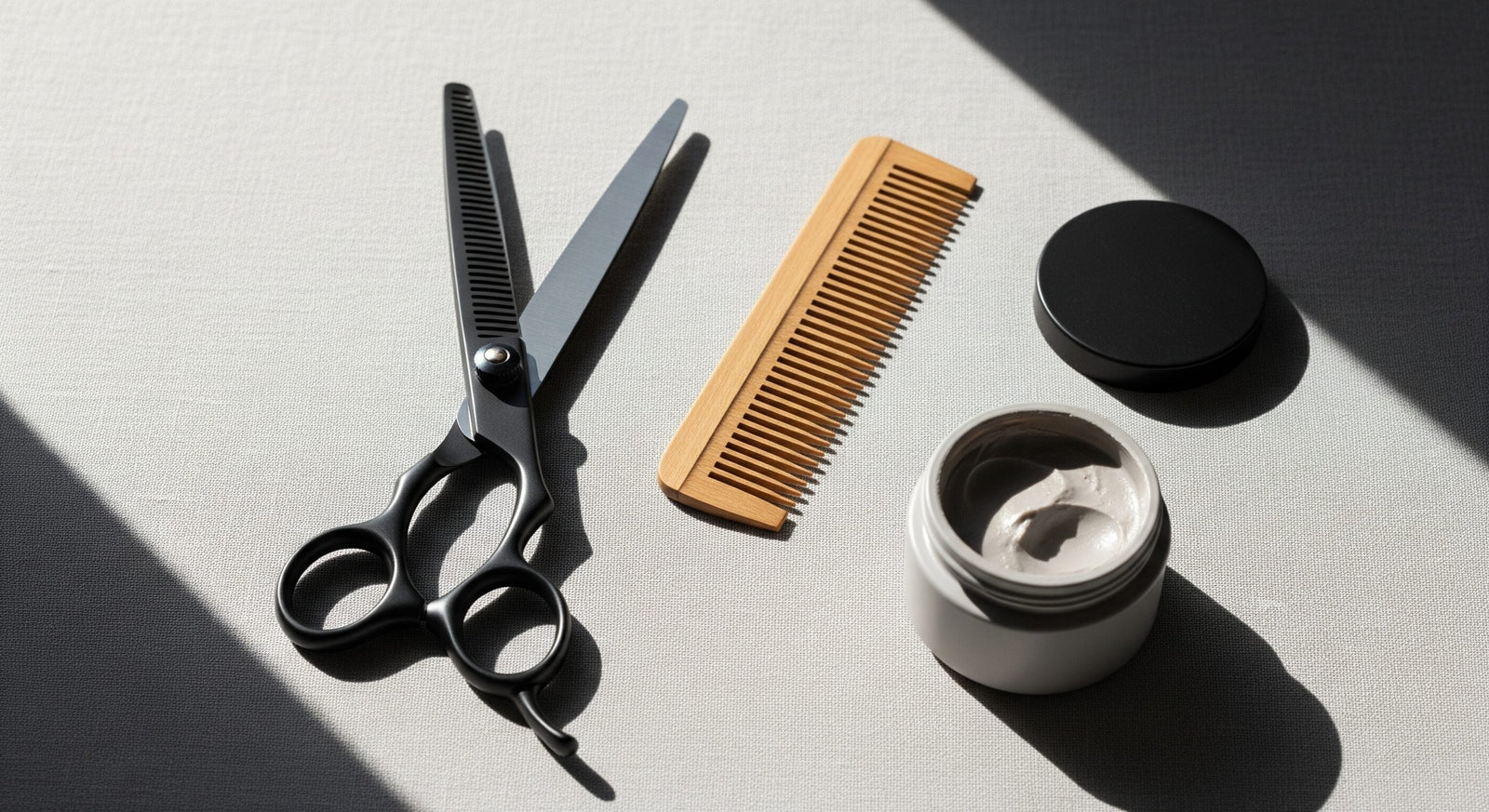
- Barber scissors. Not kitchen scissors. Not craft scissors. Proper barber shears — even a basic pair from a professional supplier — cut cleanly without dragging or splitting. You'll use these for tidying the top and blending any textured sections.
- A good comb. You need it for sectioning, guiding clippers, and scissor-over-comb work once you build confidence. Our KENT Professional Pocket Comb is a compact, well-made option that pulls double duty for grooming and cutting.
- Two mirrors. One large bathroom mirror and one handheld — this gives you the rear view that's absolutely critical for checking your neckline and blend. A ring light or decent window light also helps enormously. Cutting hair in dim light is how regrettable decisions happen.
- A trimmer or edger. For neckline definition. Your main clippers are great for bulk cutting; a dedicated trimmer gives you precision on the edges. Think of it like the difference between a roller brush and a fine brush when painting. Both have their job.
- A barber's cape or old towel. Cutting hair in a good shirt is a choice you will regret immediately and irrevocably.
Essential beginner's rules
- Always start with more length than you think you need. You can always take more off. You cannot put it back.
- Cut on dry or slightly damp hair for more accurate length reading — wet hair appears longer and leads to over-cutting.
- Work in sections. Top, sides, back — treat them separately rather than winging it from one end to the other.
- Clean and oil your clippers after every use. Blunt blades catch and pull rather than cut. That feels exactly as unpleasant as it sounds.
What products should you be using alongside your cut?
Whether you're maintaining your hair at home or touching up a barber's cut, the products you use daily make a real difference to how your hair and beard actually look and feel. A good haircut can be undermined by dry, coarse, unruly hair. A mediocre haircut can look considerably sharper when the hair itself is in good condition.

And since many of the men reading this will have a beard to contend with alongside their haircut decisions, let's talk about what your beard specifically needs during this process.
Beard Oil
If your beard is part of your overall look — and for a lot of men it is — keeping it in good condition isn't optional. Our Beard Oil uses a blend of carrier and essential oils, including jojoba oil, which is structurally very similar to the skin's natural sebum. It absorbs without leaving a greasy residue, conditioning both the hair shaft and the skin beneath it. Dry, itchy beard skin is what causes that awful flaking and rough texture. A few drops of beard oil daily sorts that out almost immediately.
We offer three scent options: the warm, woody Woodland Harmony, the bright and fresh Citrus Tonic, and the Pure Equilibrium unscented version — ideal if you're also wearing cologne and don't want competing fragrances. (If you're curious about how to layer scents properly, we covered it in our guide to wearing cologne.)
Use a penny-sized amount, warmed between your palms, worked through from roots to tips. Morning is ideal — after a shower, when the pores are open and absorption is better.
Beard Balm
Think of beard balm as beard oil with structure. Our Woodland Harmony Beard Balm combines the conditioning benefits of coconut oil, peach kernel oil, and cocoa butter with a natural beeswax base that provides light hold and shape. The cocoa butter in particular is rich in fatty acids that seal moisture into the hair shaft — especially useful if your beard tends to frizz or go rogue in cold weather.
This is your go-to if your beard is medium to long and needs both conditioning and a bit of control. Use about a pea-sized amount (or slightly more for longer beards), warmed between your palms and worked through the beard from underneath. It's particularly useful on days when you've trimmed — fresh-cut beard ends can feel sharper and drier, and the balm helps restore that softened feel quickly.
Beard Brush — Oval Shaped Pear Wood With Natural Bristles
A boar bristle brush is one of those tools that sounds like overkill until you actually use one. Natural bristles distribute both the beard's natural oils and any product you've applied evenly through the entire beard — including the patches that tend to get neglected. It also trains the hair to grow in a consistent direction over time, which matters a great deal if your beard has any maverick tendencies.
Our brush uses an oval pear wood head — comfortable in the hand — with dense natural bristles that work through the beard without scratching the skin beneath. Use it morning and evening, particularly after applying oil or balm. Thirty seconds. That's all it takes.
Together, these three products form the backbone of a solid beard maintenance routine that complements your haircut — whether that haircut happened in a barbershop or in your bathroom on a Sunday morning.
The hybrid approach: getting the best of both worlds
Nobody else writing about this topic seems particularly keen to say the obvious thing, so we will: the answer to the DIY vs. barber debate isn't to pick a lane and stay in it. It's to use both, strategically, so you get professional results at a fraction of the ongoing cost.
This is the hybrid model. It's the most practical approach for most men in 2026. Here's how it actually works.
Use a barber for the shape. Visit every six to eight weeks — or even every ten weeks — for the foundational cut. The fade, the blend, the overall structure of the style. Let them do what they do best. This is where professional expertise earns its money.
Maintain at home between visits. In the three or four weeks after a fresh barber cut, the things that lose definition first are predictable: the neckline, the sides around the ears, and any textured section on top that's grown out enough to lose its shape. All of these are manageable at home. A quick neckline tidy with a trimmer takes five minutes. It's not a full cut — it's maintenance. Big difference.
Know what not to touch. This is the critical rule. Don't attempt to re-do the blend yourself. Don't try to sharpen a fade you don't have the eye or the tools for. Maintain what you have — extend its life — and let the barber reset it properly at the next appointment.
What to maintain at home (and what to leave alone)
The neckline is yours to manage. A trimmer, a steady hand, and keep it natural — don't shave it too high or it'll look odd when the hair above it grows. The area around the ears is the same: clean it up with a trimmer, following the line the barber already created for you.
The textured top or fringe is borderline. Light scissor trimming is fine if you know what you're doing. If you're not sure, leave it. The fade and the blend, on the other hand, are entirely off-limits for home work — this is the hardest part to recreate and the easiest to ruin, so resist the urge.
Your beard neckline, though? Do that at home without question. Clean the line underneath your jaw every week or ten days. For a full rundown of getting every aspect of your grooming sorted, take a look at our head-to-toe men's hygiene guide.
The financial case for going hybrid
If you were visiting the barber every three to four weeks and paying around £25–£35 a visit (London pricing, which is its own special category), you're looking at £325–£455 annually. Drop to every six to eight weeks with home maintenance filling the gap, and that figure roughly halves — while your hair still looks sharp for more of the year, because you're actively maintaining it rather than watching it deteriorate for six weeks and then scrambling.
You spend less. You look better for more of the calendar. That's it, really.
Tips and tricks: making the hybrid model work for you
- Take a photo after every barber visit — one from each angle including the back. This is your reference point for maintenance and for briefing your barber next time. It takes thirty seconds and saves a lot of vague hand-waving later.
- Clean your clippers after every use. Oil the blades. It takes two minutes and extends the life of your clippers significantly. Blunt blades are the number one cause of uneven home cuts.
- Start your neckline maintenance early. Don't wait until the neckline looks terrible — address it when it's just starting to grow out. Much easier to tidy a slightly fuzzy line than to reclaim one that's grown an inch.
- Use your products consistently. Daily use of a quality beard oil keeps your beard soft, healthy, and presentable — which matters as much as the cut itself. A well-groomed beard alongside a slightly grown-out haircut still looks intentional. The reverse is also true, unfortunately.
- Tell your barber what you're doing at home. A good barber will respect it and may even give you specific advice about where to maintain and where to leave well alone, based on your particular hair type and style. It's a collaboration, not a competition.
- Brush your beard daily. Use your natural bristle beard brush morning and evening. It keeps everything aligned, distributes product evenly, and makes a genuine difference to the overall look within a couple of weeks of consistent use.
- Invest in one good mirror setup. Two mirrors — one wall-mounted, one handheld — are worth every penny if you're doing any home maintenance. You literally cannot see what you're doing without the rear view, and you will make mistakes based on what you think is happening versus what's actually happening on the back of your head.
- Accept the learning curve. Your first few attempts at home maintenance won't be perfect. That's fine. Keep the goals modest — clean neckline, tidy edges — and build confidence gradually. Nobody expects you to produce a textbook fade on month one.
Frequently asked questions
Is it cheaper to cut your own hair or go to a barber?
Over time, yes — considerably cheaper. A quality clipper set runs £60–£100 once. Regular barber visits at the UK average of around £13 a cut, or considerably more in major cities, add up to over £100 a year at minimum frequency. Most home setups pay for themselves within six months. After that you're essentially cutting for free.
What are the pros and cons of cutting your own hair?
The main advantages: you save money, you can do it whenever you like, and you're not dependent on anyone's schedule but your own. The downsides are real, though. There's a learning curve, mistakes are yours to live with, and some styles — skin fades, anything requiring precise blending — are just not achievable on your own head without a second pair of hands and eyes. Start simple. Build from there.
How often should a man go to the barber?
Shorter styles need attention every two to three weeks. Longer styles can stretch to six weeks or more before things start looking shaggy. If you're doing maintenance at home between visits, you can often push barber appointments out to every six to eight weeks without your look suffering — which is exactly the point of the hybrid approach.
What tools do I need to cut my own hair at home?
At minimum: a clipper set with multiple guard attachments, proper barber scissors (kitchen scissors will drag and split), a comb, two mirrors for rear visibility, and a trimmer for neckline work. A cape or old towel saves your bathroom floor. Spend a reasonable amount on the clippers — cheap ones produce inconsistent results and make you want to give up before you've actually learned anything.
The verdict
Neither the barber's chair nor the bathroom mirror wins this outright. A skilled barber will always produce a result that's difficult to replicate at home — the fade, the blend, the structural reset that comes from someone who does this all day. But DIY saves real money, fits around your actual schedule, and handles maintenance perfectly well once you know what you're doing.
The hybrid approach is where most men land when they think about this honestly: professional cuts for the complex work, home maintenance to keep the look sharp between visits, and the right grooming products to make sure everything — hair, beard, skin — stays in decent shape day to day.
Want to go deeper on building a routine that ties all of this together? Our guide on minimalist grooming for 2026 covers exactly how to keep things simple and effective without spending a fortune or an hour in front of the mirror every morning.
Start with the neckline. That's always step one.