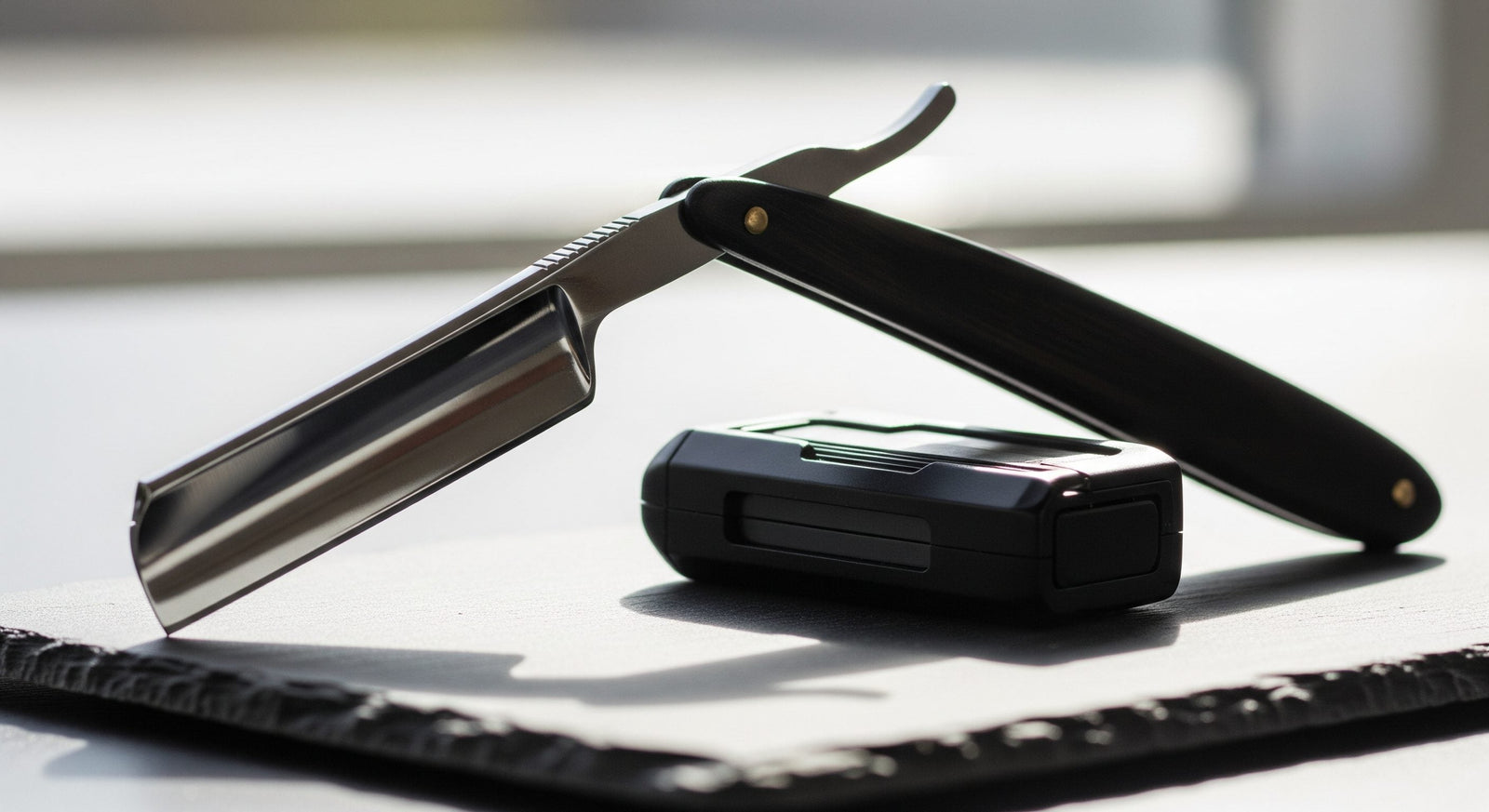

The Traditionalist vs. The Modernist: What Is a Straight Razor and a Shavette?
You've been staring at that four-blade cartridge sitting on the edge of your sink, wondering if there's something better. Something that doesn't cost you £4 a pop to replace, doesn't clog after two uses, and doesn't leave your neck looking like a geographical survey of Mars. There is. But now you've got a new problem: someone on a forum told you to buy a straight razor, your mate swears by his shavette, and you genuinely have no idea what the difference is — or which one won't leave you looking like you've had a minor altercation with a lawnmower.
Don't worry. We've been there. We've also been through enough shaving gear to fill a small museum, and we're here to give you the honest, practical breakdown that most articles either gloss over or get entirely wrong.
We'll start at the beginning, because the straight razor vs shavette debate only makes sense once you understand what each tool actually is.
The Straight Razor: The Classic
A straight razor — sometimes called a cut-throat razor — is a single, long, fixed blade attached to a handle via a pivot pin. The blade folds into the handle (called scales) when not in use, like a very serious pocket knife that you would absolutely not take through airport security. The blade is typically between 5/8" and 8/8" wide, made from either carbon steel or stainless steel, and — here's the key detail — it never gets replaced. Instead, you maintain it. You hone it on a whetstone every few months to restore the edge, and you strop it on a leather strap before each shave to realign the blade. More on that later.
A good straight razor is a proper investment. The kind your grandfather would recognise. Brands like Dovo, Thiers-Issard, and Böker make blades that, with proper care, can last decades — or longer. This is not a disposable tool. It's the grooming equivalent of a cast-iron skillet.
The Shavette: The Modern Alternative
A shavette looks almost identical to a straight razor. Same long handle, same fold-open design, same "yes I'm serious about shaving" aesthetic. The critical difference? The blade is disposable. You snap in a new one — either a half double-edge (DE) blade, a full DE blade, or an artist club-style blade depending on the model — and when it's done, you bin it and snap in a fresh one. No stropping. No honing. No whetstone collection slowly taking over your bathroom shelf.
Parker, Dovo, and Feather all make well-regarded shavettes. They're what you'll find at practically every barbershop, partly because they produce a brilliant shave but mostly because hygiene regulations in the UK (and most of Europe) mean barbers legally can't use a fixed blade on multiple clients.
Same look. Very different relationship. That's your starting point.
Head-to-head: a feature-by-feature breakdown
A direct comparison, no hedging, so you can see exactly where each razor wins, loses, and holds its own.
| Feature | Straight Razor | Shavette |
|---|---|---|
| Blade Type | Fixed, permanent steel blade | Replaceable disposable blades (half-DE, full DE, artist club) |
| Upfront Cost | £80–£300+ for a quality blade | £15–£60 for the razor body |
| Ongoing Cost | Occasional whetstone + strop (low once purchased) | Replacement blades (typically £3–£10 per 10-pack) |
| Maintenance | Regular stropping, periodic honing | Rinse and replace — that's it |
| Weight & Balance | Heavier, more substantial feel | Lighter, sometimes flimsy depending on model |
| Blade Flexibility | None — fixed geometry | Some models flex depending on blade type |
| Forgiveness for Beginners | Moderate — heavier weight aids angle control | Lower — thin, exposed blades punish poor technique |
| Shave Closeness | Exceptional — about as close as home shaving gets | Excellent — marginally less consistent |
| Hygiene | Fine for personal use; not ideal for sharing | Fresh blade every time — hygienic by design |
| Travel-Friendly? | No — not TSA/airport compliant in hand luggage | Body is fine; blades must go in checked luggage |
| Longevity | Decades, with proper care | Razor body lasts years; blades replaced frequently |
| Barber Use | Not permitted in most UK/EU professional settings | Standard professional tool |
The table doesn't lie — and it doesn't tell the full story either. Because what a table can't capture is what it actually feels like to shave with both.
The shaving experience: feel, forgiveness, and closeness
This is where things get genuinely interesting. And where most comparisons get it wrong.
The Straight Razor Experience
Pick up a quality straight razor — a Dovo, for example — and the first thing you'll notice is the weight. It feels like a tool. Substantial. Purposeful. That weight isn't incidental; it actually helps you. When you're learning to hold a straight razor at the correct 30-degree angle to your skin, the heft of the blade becomes your guide. It settles into the right position more naturally than a lighter razor would, gliding with a gravity-assisted authority that makes each stroke feel controlled.
The edge on a properly maintained straight razor is extraordinary. A well-honed blade cuts hair at skin level with almost no drag, no tugging, no irritation — when your technique is right. That "when" is doing a lot of heavy lifting in that sentence, mind you. But the point stands: the ceiling on shave quality with a straight razor is higher than almost anything else you can use at home.
The Shavette Experience
A shavette is lighter. Often noticeably so. And while that sounds like it should make it easier to handle, it actually works against beginners in a specific and frustrating way: without that weight to guide you, you have to be far more deliberate about your angle and pressure. Apply too much pressure with a fresh half-DE blade — which is significantly more exposed and rigid than a properly stropped straight razor edge — and you'll know about it immediately. Usually with a small but indignant nick on your jawline.
The shavette has one enormous practical advantage, though: the blade is always sharp. Because you replace it. A straight razor that hasn't been properly maintained — or that you've honed incorrectly — will drag and pull in a way that is neither comfortable nor efficient. A shavette sidesteps this entirely. Fresh blade in, fresh blade out. No skill required on the sharpening side of things.
Shave closeness? Both are exceptional compared to cartridge or safety razors. For most men, on most days, the difference in closeness between a well-used straight razor and a shavette with a quality blade is imperceptible. Where the straight razor wins is in the feel — that smooth, deliberate glide of a properly honed, properly stropped fixed blade is, genuinely, a sensory experience. We've said it and we meant it.
If you're curious about perfecting the technique side of things, our definitive guide to the perfect wet shave goes deep on lather, angle, and skin prep — all of which applies equally here.
The learning curve: is a shavette really easier for beginners?
Not necessarily. In fact, this is probably the biggest misconception in the entire straight razor vs shavette conversation, and I've had to correct it more times than I can count.
The common assumption goes like this: straight razor equals complicated, needs maintenance, terrifying. Shavette equals basically the same but with a fresh blade. Easier, obviously. Right?
Wrong. Or at least, incomplete.
What the first month actually looks like
With a straight razor, you're learning two things: the shaving technique, and the maintenance. The maintenance (stropping and occasional honing) has its own learning curve, but it's a separate skill you practise away from your face. The shaving technique benefits — as mentioned — from the weight of the blade, which is more forgiving of minor angle inconsistencies.
With a shavette, you're only learning the shaving technique. Sounds simpler. But the lighter weight and the more rigidly exposed, less "rounded" edge of a disposable blade means your technique has to be more precise from day one. There's less margin. The razor doesn't glide as naturally into position — you have to put it there.
What this means in practice:
- Week 1–2 (either razor): Start slow. Do one pass, with the grain only. Don't try for a baby-smooth finish. Your primary goal is learning the angle — approximately 30 degrees to the skin — without cutting yourself. Use short, deliberate strokes. Neck and jaw are the trickiest areas. Leave them for last.
- Week 3–4: You're building muscle memory. With a straight razor, your strokes are starting to feel more natural because the weight is doing some of the work. With a shavette, you may still be fighting the lightness — consciously controlling pressure in a way that feels effortful.
- Month 2 onwards: Most men find their footing by now. A second pass — across the grain — starts to become realistic. Closeness improves dramatically. Nicks become occasional rather than routine.
Common beginner mistakes (and how to avoid them)
- Applying too much pressure. Neither razor needs it. Let the weight of the blade do the work. If you're pressing, you're compensating for a technique problem, not solving it.
- Wrong angle. Too flat (under 20 degrees) and you're scraping rather than cutting. Too steep (over 40 degrees) and you risk cuts. Thirty degrees is your friend.
- Dry or poorly prepared skin. This will ruin a shave with any razor, but it's particularly unforgiving with an exposed blade. Proper lather — and proper skin prep — is non-negotiable. More on this below.
- Skipping the stretch. Use your free hand to pull the skin taut before each stroke. This creates a firm, flat surface for the blade. Skip this step and you're asking for nicks in the curves of the jaw and neck.
- Shaving against the grain on the first pass. Don't. Learn your grain direction (it changes on different parts of your face) and always go with it first. Against-the-grain passes are for experienced users chasing that extra closeness.
A shavette is the lower-maintenance choice, not the easier one. Those are different things. If you're completely new to both, the heavier straight razor may actually be more forgiving in your hand — even if it seems more intimidating on the shelf.
Upkeep and maintenance: stropping rituals vs. disposable simplicity
This is where the two razors diverge most dramatically — and where your lifestyle genuinely should influence your choice.

Straight razor maintenance
A traditional straight razor has a fixed blade that requires periodic honing and stropping before each shave to maintain its edge. Periodic and before each shave are the key words there — they're different jobs.
Stropping is the daily ritual. Before every shave, you run the blade along a leather strop — usually around 20–30 laps — to realign the microscopic teeth of the blade's edge that have folded slightly from the previous shave. It takes about two minutes. It's actually rather satisfying, once you get it. There's a whole subcultural appreciation for the sound and rhythm of stropping that I completely understand and will not apologise for.
Honing is the less frequent, more involved process. Every few months — depending on how often you shave — the blade needs to go on a whetstone to restore the sharpened edge. This is a skill. It takes time to learn. Many men, especially those starting out, send their razors to a professional honemeister rather than doing it themselves. That's a perfectly reasonable approach. It costs a few pounds and keeps your razor properly sharp without you needing to invest in a full set of Japanese whetstones. (Though, fair warning: the whetstone rabbit hole is deep and dangerously enjoyable.)
Shavette maintenance
There isn't any. Not really. Rinse the blade after each stroke while shaving, dispose of it when it starts to feel less sharp (typically after 2–4 shaves with a half-DE blade), and wipe down the razor body. Done. The simplicity is genuinely appealing — particularly if your mornings are more "running out the door" than "contemplative grooming ritual."
The ongoing cost of blades is real but modest. A 10-pack of quality half-DE blades costs a few pounds, and if you're shaving three times a week and replacing blades every two to three shaves, you're looking at a very manageable ongoing spend. Nowhere near what you'd spend on cartridge replacements, for the record. Over five or ten years, a straight razor with its one-time investment (plus minimal maintenance costs) will almost certainly cost you less.
The bottom line: making the right choice for your shave
Actual guidance, not hedged non-answers.
Go with a straight razor if you enjoy the ritual and see shaving as time for yourself rather than a chore to rush through; if you're willing to invest the time to learn stropping and basic maintenance; if you want a tool you'll own for decades with genuine craftsmanship behind it; and if you shave at home exclusively and don't need to travel with your kit.
Go with a shavette if you want the aesthetic and quality of straight-razor shaving without the maintenance commitment; if you travel frequently (the razor body is fine in hand luggage, blades go in checked bags); if you're primarily using it for beard line-ups and neck clean-up rather than a full face shave; or if you want a lower upfront cost while you figure out whether straight-razor shaving is actually for you.
Consider owning both. Genuinely. Many experienced wet shavers use a straight razor for weekend mornings when they have time, and a shavette for weekday neck clean-ups or travel. The two aren't mutually exclusive — they're complementary tools for different moments. It's a bit like owning both a good coffee machine and a cafetière. Different occasions, different vibes, both excellent in their context.
You might also find our guide to building your ultimate grooming routine helpful here — it puts shaving in context with the rest of your morning.
What products should I use? Perfecting your pre- and post-shave ritual
Most straight razor and shavette articles completely ignore this part. The razor is only part of the equation. A brilliant blade on unprepared skin is like a sports car on a gravel track — technically capable, practically disappointing. Your pre- and post-shave routine will determine whether you get a comfortable, close shave or an irritated, red-faced mess.
Before you shave: prepare properly
The single best thing you can do before picking up either razor is use a pre-shave oil. Our Pure Equilibrium Pre-Shave Oil is formulated with lightweight natural oils that sink into the skin to soften both hair and the uppermost layer of skin, creating a slicker surface for the blade to glide across. A slicker surface means less drag, which means less irritation — and with an exposed blade, that matters more than with almost any other razor type.
Apply a few drops to damp skin after your shower, massage in gently, then build your lather on top. Oil under lather, in that order — it's the standard barbershop approach, and it works.
Your lather matters too. Our Shaving Cream is a natural formula that builds a dense, cushioning lather — not the airy foam from a pressurised can, which provides almost zero blade protection. Work it in with a quality shaving brush using circular motions to lift the hairs and work the cream into the skin. You want a lather you could practically stand a spoon in. That's your cushion between blade and skin.
After you shave: don't skip this step
Post-shave care is where most men fall down. You've just removed the top layer of dead skin along with your stubble — that's a minor trauma for your face, even with perfect technique. What you put on next matters enormously.
Our Post Shave Balm is alcohol-free — so none of that eye-watering sting that does absolutely nothing useful — and delivers a blend of soothing, anti-inflammatory botanicals and humectants that get to work on redness and irritation immediately, while starting to pull moisture back into the skin. Apply a small amount — about a pea-sized blob — and work it gently into the freshly shaved areas.
Follow that with our Anti Ageing Moisturiser. This is not an optional extra. Freshly shaved skin is more permeable and absorbs active ingredients more efficiently than at any other point in your day — the peptides and antioxidants in this moisturiser are essentially getting a free pass straight through. A penny-sized amount, worked into the face and neck, seals everything in and leaves your skin comfortable and healthy-looking for the rest of the day.
We've written about how this fits into a broader anti-ageing approach in our 2026 anti-ageing routine guide — worth a read if you want to get more out of your skin over the long term.
For the bearded gentlemen
If you're using a straight razor or shavette primarily for beard line-ups — keeping the cheek lines, neckline, and moustache edges sharp rather than full-face shaving — you'll want to make sure the beard itself is in good condition too. A well-maintained beard makes clean lines dramatically easier to achieve and maintain.
A good beard oil applied daily — a few drops worked through from roots to tips — keeps the hair soft, the skin underneath hydrated, and the overall shape manageable. And if your beard is longer and needs a bit of hold and structure, our Beard Conditioner softens coarse hair and improves manageability, making it far easier to see where your lines actually are before you pick up the razor. Trying to edge a dry, frizzy beard is roughly as productive as trying to iron a duvet. Don't do it.
You can find the complete Full Shave Kit on our site, which brings together everything you need for a proper wet shave in one place.
Tips and tricks: practical advice for straight razor and shavette users
- Always shave after a shower. Warm water softens both the hair follicle and the skin, and five minutes of steam makes a noticeable difference to how the blade feels moving across your face. Cold-starting a shave with a straight blade is asking for trouble.
- Map your grain direction before you start. Run your fingers across your stubble and feel which direction resistance increases. It varies — most men grow downward on the cheeks but at an angle on the neck — and knowing this before you pick up the razor saves you from going against the grain accidentally on your first pass.
- For shavettes: start with a half-DE blade. Half-DE blades are slightly less exposed and a little more forgiving than full DE. Artist club-style blades (used in Japanese shavettes) are sharper still and best left until you've got the technique dialled in.
- For straight razors: test the strop before you buy. A leather strop that's too stiff won't realign the blade properly — it should have some give. Canvas strops (often the "pre-strop" side of a combination strop) help clean the blade; leather realigns the edge. Use both, in that order.
- Don't rush the lather. Thirty seconds of proper lathering with a brush makes a quantifiable difference to how the blade moves. (Pun partially intended.)
- Use short strokes. Long, dramatic swoops look great in grooming adverts. In practice, short strokes — 2–4 cm — give you more control over the blade angle at all points in the stroke, because there's less distance over which the angle can drift.
- Rinse the blade every two to three strokes. Lather loaded with hair clogs the blade and reduces cutting efficiency. Quick rinse, shake once, continue.
- For beard line-ups with a shavette: mark your lines first. A white eyeliner pencil or a fine comb to mark your intended cheek and necklines before you start sounds fussy. It absolutely works. Much easier to follow a visual guide than to freehand a symmetrical cheek line with a live blade.
- Cold water rinse at the end. Once you're done, rinse with cold water to close the pores and reduce post-shave redness before your balm and moisturiser go on.
- Store your straight razor open and dry. Folding it wet traps moisture between the blade and scales, which can cause rust or pit the blade over time — especially on carbon steel. Ten seconds with a soft cloth before you fold it away is all it takes.
Frequently asked questions
Is a shavette better for beginners?
Not necessarily — and this is one of the most common myths in the straight razor vs shavette debate. A shavette requires no maintenance skills like stropping or honing, but its lighter weight and more exposed blade can actually be less forgiving for someone still learning blade angle and pressure control. Many beginners find the weightier straight razor settles more naturally into the correct angle, making technique development slightly more intuitive in the early weeks.
Is it worth switching to a straight razor?
If you enjoy the ritual of shaving, are willing to invest time in learning proper maintenance, and want the best possible long-term value — yes, absolutely. A quality straight razor will outlast every cartridge system and eventually cost far less. The shave quality is hard to beat. It does demand patience, though; if you want simplicity above everything else, a shavette or double edge safety razor may suit your lifestyle better.
Do you need to strop a shavette?
No — and this is one of the shavette's clearest practical advantages. Because the blade is disposable, there's no edge to realign; you simply replace it when it starts to feel less sharp, which is typically after two to four shaves depending on the blade brand and your stubble coarseness. The razor body itself just needs a rinse and occasional wipe-down, which is about as low-maintenance as wet shaving gets.
Whatever you choose, the fact that you're here, thinking seriously about your shave, already puts you ahead of most men still dragging a five-blade cartridge across their face with no prep and a face full of regret. Used properly, either tool will give you a shave worth looking forward to. Get the technique right, prep your skin properly, and look after yourself before and after the blade touches your face.
And if you want to take your overall grooming game further, have a look at our head-to-toe men's hygiene guide — it's the kind of thing you read once and reference for years.