
You finally decided to grow that beard you've been thinking about for years. Maybe you saw someone rocking a full, thick beard — Idris Elba, perhaps, or a well-groomed bloke at a wedding — and thought: yes, that's the look. That's me. So you put the razor down, you committed, and you waited.
And then... patches. Gaps. A chin that's coming in nicely but cheeks that look like a moth got at them.
Don't worry. We've been there. Most of us have. And the great news is that a patchy beard is far more manageable than the internet would have you believe — you definitely don't need to book a hair transplant to sort it out. What you do need is the right information, a bit of patience, and a solid grooming routine.
That's exactly what this guide is. We're going to walk you through why your beard is patchy, what you can realistically do about it, and how to look great in the meantime. Because plenty of men with patchy beards look absolutely brilliant. They've just learned how to work with what they've got.
And if you want to make sure your whole look is dialled in while you're growing things out, have a read of our guide to first impression grooming — because a beard is only one part of the picture.
Why is your beard patchy? Understanding the causes
There's a tendency online to jump straight to solutions without explaining the why. But if you don't understand the cause, you're just guessing. And guessing with your face is never a good strategy.
Why is your beard patchy? The honest answer is: it could be one of several reasons, and more than one can be happening at the same time.
1. Genetics
The most common culprit, and also the one least within your control. The thickness, density, and growth pattern of your beard is largely written in your DNA. If your dad or grandfather had a patchy beard, there's a reasonable chance you will too. It's not a failing. Genetics set the ceiling, not the floor. You can still make the most of what you've got.
2. Age
Most men don't reach their full beard potential until their early to mid-30s, so if you're in your 20s struggling with gaps, you're not alone and the story isn't finished yet. Some men find their beard fills in significantly between 25 and 35 as their hormone levels mature.
3. Hormonal imbalances
Androgen hormones — testosterone and DHT in particular — are what drive beard growth and fullness. If your levels are off, your beard will reflect that. This doesn't mean every patchy beard is a hormonal issue, but if you're seeing sudden changes in hair growth alongside other symptoms (fatigue, mood shifts, weight changes), it might be worth a conversation with your GP. Don't self-diagnose based on a Reddit thread.
4. Nutritional deficiencies
Deficiencies in iron, zinc, vitamin D, biotin, and protein can all affect hair growth, including facial hair. Your body prioritises its most vital functions first, and if you're running low on key nutrients, hair growth tends to be one of the first things to take a back seat. More on this in the lifestyle section.
5. Alopecia areata (alopecia barbae)
This one is worth knowing about. Alopecia barbae is a form of alopecia areata, an autoimmune condition that causes hair loss, and in the case of alopecia barbae, it specifically affects the beard. It typically presents as distinct circular patches rather than general thinning. If you're noticing very defined round bald spots in your beard rather than just sparse or uneven growth, please see a dermatologist. That's not something grooming products will fix, and a professional can help. As a general rule: if your patches appeared suddenly or have a circular, coin-like shape, get them checked.
6. Stress and poor sleep
Both chronic stress and consistently poor sleep can disrupt your body's normal hormonal rhythms and, by extension, your hair growth cycles. It's not the most dramatic cause of patchiness, but it's more common than most men realise.
7. Skin health
Dry, flaky skin can clog hair follicles and physically impede growth. If you've never thought about skincare as part of your beard routine, this might be the wake-up call you needed. A healthy follicle needs a healthy foundation.
For most men, patchiness comes down to genetics and age. Hormones, nutrition, health conditions, and lifestyle all play a part too. Understanding which is affecting you — or which combination — changes how you approach the solution.
The virtue of patience: your 90-day growth plan
Here's where most men go wrong.
They grow their beard for two weeks, decide it looks awful, and reach for the razor. What they don't realise is that two weeks is basically day one in beard terms. The patchy, uneven, slightly embarrassing stage is not the finished product. It's the ugly duckling phase. You have to push through it.
Give it time. We're talking at least 90 days — roughly three months — of letting it grow without trimming the bulk, just to see what you're actually working with. As hairs grow longer, they start to lie across sparser areas and create the illusion of density. Those gaps that look enormous at three weeks often become barely noticeable at ten weeks.
Now, this doesn't mean ignoring your beard for three months and hoping for the best. It means:
- Don't trim the length — resist the urge. You're building the raw material here.
- Do clean up the edges — your neckline and cheek lines can still be maintained. In fact, they should be. A defined edge makes even uneven growth look intentional.
- Keep the skin and hair healthy — moisturise, oil, and brush. We'll get to the specifics shortly.
- Manage your expectations week by week — take photos every two weeks. You'll be surprised how much changes when you compare week two to week eight.
There's also an honest conversation to be had here about the psychological side of all this. Growing out a patchy beard can knock your confidence. You walk into work looking like you forgot to shave rather than growing something intentional. People make comments (they always do). It's mildly irritating at best, genuinely demoralising at worst.
But here's the reframe: most of the people commenting at week two won't be commenting at month three. They'll be asking you what you've been doing differently. The 90-day commitment is one of the few things in men's grooming that actually pays off, and it costs you nothing except patience.
We've written more about how your look changes across seasons in our seasonal grooming guide, which is well worth a read while you're committing to this growth phase.
Strategic trimming and shaping for a fuller appearance
Once you've given your beard the time it needs, trimming is your best friend. Done well, it doesn't make your beard thinner — it makes it look intentional, structured, and considerably fuller. Done badly, of course, it makes everything worse. So let's do it well.
Clean lines are everything
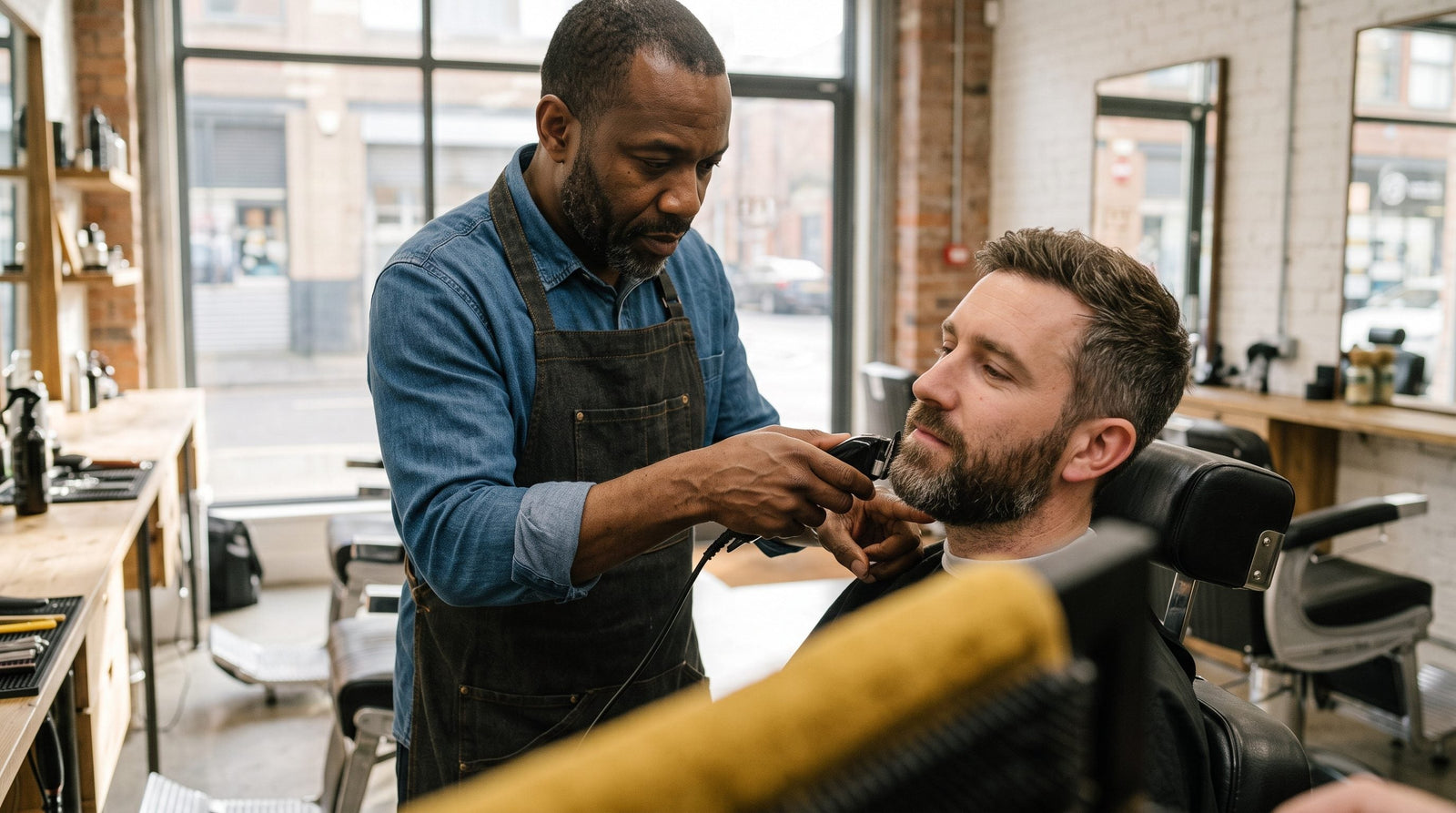
A well-defined neckline and clear cheek lines are the difference between "growing a beard" and "has a beard." Even a patchy beard looks significantly more polished when the edges are sharp. Your barber can help you establish the right lines for your face shape — and if you're not sure about the relationship between your beard and your haircut, this guide to matching haircut and beard styles is a good starting point.
Choose a style that works with your pattern
This is where most guides fall flat. They say "trim your beard" without telling you which style actually suits your particular pattern of patchiness.
| Patchiness pattern | What it looks like | Best style to try | What to avoid |
|---|---|---|---|
| Weak cheeks, strong chin and jaw | Full growth along jawline, sparse high on cheeks | Short-boxed beard, low fade beard | Full beard with high cheek line — highlights the gaps |
| Disconnected moustache | Gap between upper lip and chin growth | Classic goatee, chin curtain | Keeping a thin, isolated moustache — it draws attention to the disconnect |
| Patchy sides, strong chin | Growth concentrated on chin and jaw but thin on the sides | Chin strap, Van Dyke | Trying to grow out the sides — they'll just look sparse |
| Generally thin all over | Even but low-density growth across the face | Short stubble (3–5mm), kept tight and uniform | Attempting a full beard — length exaggerates thinness |
| Patches on the neck/chin only | Strong cheeks and moustache, sparse on chin | Extended goatee, balbo beard | High neckline that exposes the patchy area |
You're not hiding your beard. You're designing around its natural growth pattern. Some of the best-looking beards in the world are not full beards — they're well-executed styles that work with what a man's genetics gave him.
Uniform length matters
Getting your beard hairs to a more uniform length — rather than letting some grow wild and others stay short — helps accentuate the areas where your growth is strongest. A good quality trimmer and a steady hand (or a trip to the barber) goes a long way here.
Fuelling growth from within: lifestyle actually matters
This section is not going to tell you to "drink more water and sleep eight hours" and leave it at that. You've heard that. Let's talk about why these things actually affect your beard, and what specifically to focus on.
Facial hair growth is directly affected by nutrition, exercise, rest, and stress levels. These aren't platitudes — they directly affect the hormonal environment and cellular processes that determine whether your hair follicles are active and productive.
Nutrition and specific deficiencies
Deficiencies in iron, zinc, vitamin D, biotin, and protein are all linked to impaired hair growth. Here's what to actually do about it:
- Protein — Hair is made of keratin, which is a protein. If you're not eating enough protein, your body won't prioritise growing hair. Get adequate protein through meat, fish, eggs, legumes, or dairy.
- Biotin (Vitamin B7) — Plays a role in cell regeneration and keratin infrastructure. Found in eggs, nuts, sweet potatoes, and salmon. Biotin supplements are widely available if your diet is lacking.
- Zinc — Supports hormone production and helps repair tissues, including hair follicles. Red meat, shellfish, and pumpkin seeds are good sources.
- Vitamin D — Linked to hair follicle cycling. Many men in the UK are deficient, especially through autumn and winter. A supplement is sensible for most of us.
- Iron — Iron deficiency is a well-known cause of hair thinning. If you're persistently tired alongside patchy growth, it's worth getting your iron levels checked by your GP.
Exercise
Regular resistance training supports healthy testosterone levels. You don't need to become a gym obsessive, but getting in consistent sessions has a meaningful positive effect on the hormonal environment that drives beard growth. A bonus: it also reduces cortisol, the stress hormone that can interfere with hair growth cycles.
Sleep
A significant amount of cellular repair — including in hair follicles — happens during deep sleep. Consistently getting less than six hours is going to show up eventually, and often it shows up on your face first. Seven to nine hours is the range most men function best in.
When to see a doctor
If you've addressed all of the above and your beard still isn't progressing as expected — especially if you're experiencing sudden patches, circular bald spots, or significant changes in hair growth — please see a healthcare professional. Alopecia barbae, thyroid issues, and hormonal conditions are all treatable when caught early, and no grooming guide can substitute for proper medical advice.
The products that actually make a difference
Now we're into territory we know extremely well. And for a patchy beard specifically, the brush-oil-balm combination is the one routine change that shows up most visibly, most quickly. I've seen men dismiss the brush as optional fluff, use it for a month, and wonder why they didn't start sooner. It's not optional.
Beard oil: the foundation
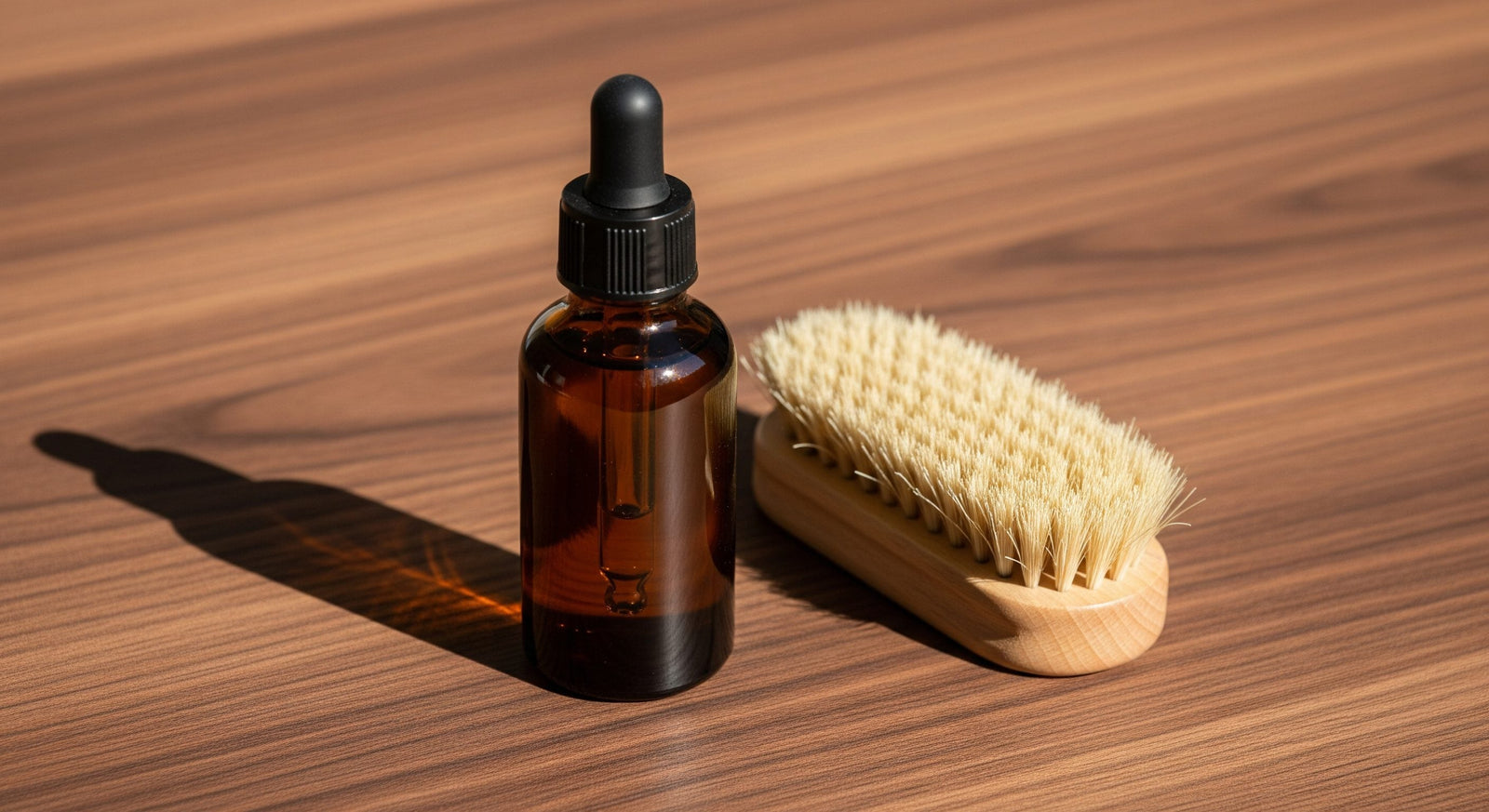
A good beard oil does two things that matter enormously for patchy beards. First, it moisturises the skin beneath the beard — healthy, hydrated skin is the environment that hair follicles need to function properly. Second, it conditions the hair you do have, making it softer, more manageable, and easier to train across sparse areas.
Our beard oils are built around carrier oils that actually work with your skin's biology. Jojoba oil closely mimics the skin's natural sebum, which means it absorbs well without clogging follicles or leaving a greasy residue. Argan oil is high in oleic and linoleic acids, which help strengthen and condition each hair shaft. Together, they create a healthier foundation for everything else you're going to do.
We have three scent options: the Woodland Harmony (warm, musky, cedarwood and sandalwood), the Citrus Tonic (fresh, bright, good for summer), and Pure Equilibrium for the fragrance-free gentleman. A few drops worked into the skin and hair after washing is all you need — don't overdo it or you'll end up looking like you've just deep-fried something.
Beard balm: hold and coverage
Where beard oil conditions, beard balm trains. Our Woodland Harmony Beard Balm combines the nourishing properties of coconut oil, peach kernel oil, and cocoa butter with the light hold of natural waxes. That hold is what makes balm particularly useful for patchy beards — it keeps the longer hairs lying in the direction you've brushed them, covering sparse areas rather than springing back out of place.
Think of it as the finishing product in your routine. After you've applied oil and brushed your beard into shape, a penny-sized amount of balm worked through with your fingers locks everything in. It also gives your beard a healthy sheen without making it look wet or greasy.
The beard brush: your most underrated tool
The beard brush is almost always the most overlooked item in the routine, which is a shame because for patchy beards it's probably doing more work than anything else. A good boar bristle brush does several things at once:
- It trains hairs to grow and lie in a consistent direction — over time, this means longer hairs reliably cover the sparse areas you want them to cover.
- It exfoliates the skin beneath the beard, removing dead skin cells that can clog follicles.
- It distributes the beard oil you've applied evenly from root to tip.
- It adds volume and body to the beard, making it look fuller.
Our oval-shaped pear wood brush uses natural boar bristles — firm enough to work through a medium-length beard, gentle enough not to cause breakage. Use it daily, always in the same direction you want your beard to grow. A week of brushing won't show much. A month will.
If you travel regularly and want something more portable, the handled travel beard brush does the same job and fits easily into a washbag.
And if you want to get everything you need in one go, our Beard Grooming Set — which includes beard oil, beard shampoo, and the brush — is a solid starting point at a price that won't sting.
Day-to-day styling techniques that make the biggest visual difference
So you've been patient, you've been consistent with your products, and you've chosen a style that works with your growth pattern. Now for the day-to-day techniques that actually shift how your beard looks.
The brush-then-balm method
This is your daily workhorse. After washing your face, apply two to three drops of beard oil and work it through to the skin, then take your beard brush and direct all your hairs the way you want them to lie — specifically, directing hairs from fuller areas across any patches. Then seal everything in place with a pea-sized amount of beard balm. It takes about ninety seconds once you've got the hang of it, and the difference in how full your beard looks is immediate.
Don't fight your natural growth direction
Most men brush their beard in a way that fights against how the hairs naturally grow. That's a battle you won't win. Instead, understand your natural grain and work with it — use the brush to redirect slightly, not to force a completely unnatural direction. Hairs that are going the wrong way will pop back up by lunchtime.
Keep it clean
A dirty, flaky beard looks thinner — there's no getting around it. Use a proper beard shampoo two to three times a week, not regular shampoo, which strips the natural oils from your facial hair and dries the skin underneath. Our Woodland Harmony Beard Shampoo cleanses without stripping, leaving the hair manageable and the skin comfortable.
Photograph your progress
Take a photo every two weeks in the same lighting. It sounds a bit vain, but it's genuinely useful — growth is gradual enough that you won't notice it day to day, but comparing week two to week ten is often a revelation. It also keeps you motivated when the itchy awkward phase is making you question your choices.
What products should I use for a patchy beard?
If you're starting from scratch, here's what we'd recommend and why:
- Seven Potions Beard Oil — Available in three scents. Apply daily to moisturise the skin and condition the hair. The jojoba and argan base means it absorbs properly rather than just sitting on top of the skin. Start with three to four drops and adjust from there.
- Seven Potions Woodland Harmony Beard Balm — Apply after the oil and after brushing. The cocoa butter and coconut oil deeply condition the hair while the natural wax gives you the hold to keep everything in place. A penny-sized amount is plenty for most beard lengths.
- Seven Potions Beard Brush — Use this every single day. Train your hairs. Exfoliate the skin. Distribute the oil. It's the most underrated step in any beard routine, and for patchy beards especially, it's the tool that produces the most visible change over time.
- Seven Potions Beard Shampoo — Two to three times per week. Clean skin is healthy skin, and healthy skin grows better hair.
If you want the lot in one place, the full beard care bundle covers all the bases and then some.
Your daily patchy beard routine
- Morning: Wash your face (or use beard shampoo on wash days). Pat dry — don't rub. Apply three to four drops of beard oil, work it into the skin and hair. Brush in your desired direction with the boar bristle brush. Apply a penny-sized amount of beard balm, shape with fingers.
- Evening: If your skin feels dry, a drop or two of beard oil before bed is worth doing — it gives the oil overnight to work on the skin without being disturbed.
- Every two to three days: Wash with beard shampoo. Regular shampoo strips the oils you're working hard to maintain — don't undo your own work.
- Weekly: Check your neckline and cheek lines. Clean, defined edges make patchy growth look intentional. A quality safety razor for edge maintenance is a worthwhile investment.
- Monthly: Reassess your style. As your beard grows, the style that worked at month one might not be the best choice at month three. Be willing to adapt.
- Ongoing: Take photos every two weeks. Eat well. Sleep. Exercise. The basics are boring, but they're the reason the products actually work.
- Emotionally: Be patient with yourself. A lot of men give up at week three. Most of the men who look great with a beard are the ones who didn't.
Frequently asked questions
Can you actually fix a patchy beard?
You can absolutely improve the appearance of a patchy beard through strategic styling, consistent grooming, and the right products — and for many men, the beard does genuinely fill in with time. However, if there are areas with no active hair follicles at all, those specific spots won't grow hair naturally, regardless of what you apply. For most men, the goal is maximising what they have, styling intelligently, and giving their beard the time and conditions it needs to reach its full potential.
Will a patchy beard ever fill in?
For many men, yes — especially if you're in your twenties, since most men don't reach their full beard potential until their early to mid-30s. Improvements in nutrition, sleep, exercise, and stress levels can also make a meaningful difference to growth over time. If your patches are caused by a condition like alopecia barbae or a hormonal imbalance, addressing the underlying cause with medical support can lead to significant improvement.
How do you make a patchy beard look fuller?
The most effective combination is letting the beard grow for at least 90 days (longer hairs naturally cover sparse areas), using a boar bristle brush daily to train hairs across patches, applying beard balm to hold them in place, and choosing a beard style that suits your specific growth pattern rather than fighting it. Clean, defined edges also make a huge difference — a well-groomed patchy beard always looks better than an unkempt full one.
Worth saying plainly
A patchy beard is not a life sentence. It's a starting point.
The men who end up with great-looking beards aren't always the ones with the best genetics — they're the ones who understood what they were working with, gave it the time it needed, and took care of it properly along the way. That's entirely within your reach.
Put the razor down. Give it ninety days. Use the right products. Train those hairs with a proper brush. Eat well, sleep properly, and stop comparing your week two to someone else's year two.
When the beard does come in, our guide to beard and haircut combinations is a good next read — because you'll want the whole look to work together.